How a Sensor Measures Both Small Wiggles and Big Shakes
This patent describes a sensor package that combines multiple smaller sensors, each designed to measure movement (acceleration) over a different range, allowing it to detect both tiny vibrations and strong impacts.
Original patent title: “Multiple axis transducer with multiple sensing range capability”
This patent describes a sensor package that combines multiple smaller sensors, each designed to measure movement (acceleration) over a different range, allowing it to detect both tiny vibrations and strong impacts. Granted to Freescale Semiconductor in 2010 with 20 claims and 34 forward citations, and it is expected to expire in 2027.
Coverage
What does this patent actually cover?
The patent describes a "transducer package" which is a multi-axis accelerometer. It uses a "substrate" (a base layer) with two perpendicular "axes of symmetry." On this substrate, it places at least two individual "sensors." A key feature is that the "first sensor" is designed to detect movement over a "first acceleration g level range," while the "second sensor" detects movement over a "second acceleration g level range," and these ranges are different (ClaimclaimA numbered sentence at the end of a patent that legally defines what the inventor owns. The most important section.Read more → 1). For example, one sensor might be very sensitive to small movements, while another can handle very strong forces without being damaged or saturated. These sensors are arranged symmetrically on the substrate and detect movement along orthogonal (perpendicular) directions. Claim 5 further details that each sensor can include a "proof mass" that moves, "sense fingers," and "fixed fingers" that form a "differential capacitive structure" to measure the movement. An example usage would be a smartphone that can detect both subtle tilt changes for screen rotation and the sudden, strong acceleration of a drop.
The gap
What does this patent NOT cover?
- A sensor package containing only a single accelerometer, or multiple accelerometers that all have the exact same sensing range.
- Sensor arrangements that are not symmetrically placed on a substrate with respect to its axes of symmetry.
- Motion sensors that do not measure acceleration, such as gyroscopes (which measure rotation) or magnetometers (which measure magnetic fields).
- Accelerometers that do not use a "proof mass" or "differential capacitive structure" as described in ClaimclaimA numbered sentence at the end of a patent that legally defines what the inventor owns. The most important section.Read more → 5.
- Sensors that detect movement in directions not substantially parallel to the substrate's axes of symmetry.
These exclusions are unique to PatentBrief — derived from the actual claim language, not patent-office boilerplate.
Key facts
What made this novel
The noveltynoveltyThe requirement that an invention be different from anything publicly known before its priority date.Read more → lies in integrating multiple accelerometers with different sensing ranges onto a single, symmetrically balanced package, each detecting movement along orthogonal axes. This allows the device to offer both high sensitivity for small movements and high dynamic range for large impacts, all within a compact and robust design.
The Patent Drawing
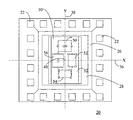
Schematic visualization of the patent's claim structure. Hand-drawn diagrams in progress for each landmark patent.
Where you've seen this
Real-world examples
Automotive airbag deployment systems
Smartphone drop detection and screen orientation
Industrial machine vibration monitoring
Gaming console controllers (e.g., Wii Remote)
Wearable fitness trackers
Why it matters
The bigger picture
This technology is important because many applications need to measure a wide variety of motions. For instance, an airbag sensor in a car needs to detect a severe crash (high g-level) but also needs to be robust enough not to trigger from a pothole (low g-level). Similarly, a smartphone needs to detect subtle gestures (low g-level) while also surviving a drop (high g-level). By combining different sensing ranges, this patent allows for a single, compact device to handle both extremes effectively.
Filed
February 21, 2007
Granted
August 24, 2010
Market context
Who's building on this
Companies in this space
NXP Semiconductors (formerly Freescale Semiconductor) continues to be a major supplier of accelerometers and other sensors for automotive, industrial, and consumer applications. Other companies like Analog Devices, STMicroelectronics, and Bosch Sensortec also develop and manufacture advanced multi-axis accelerometers that often incorporate principles of multi-range sensing for various applications.
Market impact
This type of multi-range accelerometer design significantly improved the performance and reliability of motion sensing in many products. It enabled more robust crash detection in automotive safety systems and allowed consumer devices like smartphones and gaming controllers to accurately interpret both subtle user gestures and strong physical impacts, contributing to the widespread adoption of motion-sensing interfaces.
Claim 1 — Plain English
What this patent covers
The patent describes a "transducer package" which is a multi-axis accelerometer. It uses a "substrate" (a base layer) with two perpendicular "axes of symmetry." On this substrate, it places at least two individual "sensors." A key feature is that the "first sensor" is designed to detect movement over a "first acceleration g level range," while the "second sensor" detects movement over a "second acceleration g level range," and these ranges are different (Claim 1). For example, one sensor might be very sensitive to small movements, while another can handle very strong forces without being damaged or saturated. These sensors are arranged symmetrically on the substrate and detect movement along orthogonal (perpendicular) directions. Claim 5 further details that each sensor can include a "proof mass" that moves, "sense fingers," and "fixed fingers" that form a "differential capacitive structure" to measure the movement. An example usage would be a smartphone that can detect both subtle tilt changes for screen rotation and the sudden, strong acceleration of a drop.
The clever bit
The novelty lies in integrating multiple accelerometers with different sensing ranges onto a single, symmetrically balanced package, each detecting movement along orthogonal axes. This allows the device to offer both high sensitivity for small movements and high dynamic range for large impacts, all within a compact and robust design.
What it does not cover
- A sensor package containing only a single accelerometer, or multiple accelerometers that all have the exact same sensing range.
- Sensor arrangements that are not symmetrically placed on a substrate with respect to its axes of symmetry.
- Motion sensors that do not measure acceleration, such as gyroscopes (which measure rotation) or magnetometers (which measure magnetic fields).
- Accelerometers that do not use a "proof mass" or "differential capacitive structure" as described in Claim 5.
- Sensors that detect movement in directions not substantially parallel to the substrate's axes of symmetry.
Patent timeline
Application submitted to the patent office
Application published, typically 18 months after filing
Patent officially issued
Patent enters public domain
PatentBrief Score
Impact Score
Moderate
Citation count
31/40
Moderately cited
Claim breadth
13/20
Broad claimsclaimsThe numbered statements at the end of a patent that legally define what the inventor owns.Read more →
Recency
5/20
Granted 10–20 years ago
Assignee scale
0/20
Independent or smaller assigneeassigneeThe entity that owns the patent — usually the inventor's employer or a company.Read more →
PatentBrief Impact Score — based on citation count, claim breadth, recency, and assignee scale. Not a legal assessment.
Heuristic Value Estimate
What this patent might be worth
$33K – $105K
Midpoint $66K · expired or expiring · industry ×1.5
Heuristic only — blends forward/backward citation counts, claim scope, time remaining, litigation history, and CPC-derived industry baseline. Real valuations need a professional appraisal.
Patent Claims
0 independent claims · 1 dependent
Claims are the legal boundaries of the patent. An independent claim stands alone. A dependent claim adds limitations to its parent, narrowing — but not broadening — the scope.
The original legal language
Original claims
20 claims as filed with the patent office.
Concepts involved
Citations
Patent lineage
Cite this patent
Li, G. G., Monk, D. J., & Miller, T. F. (2010). How a Sensor Measures Both Small Wiggles and Big Shakes (U.S. Patent No. 7,779,689). U.S. Patent and Trademark Office. https://patentbrief.org/patent/us/7779689/multiple-axis-transducer-with-multiple-sensing-range-capability
Auto-generated from the patent record. Double-check author order and the issue date against the official USPTO document before submitting.
Embed
Add this patent to your site
Drop this plain-English patent card into any blog post or article — free, no signup. It always links back to the full breakdown here.
<div data-patentlens-widget data-patent-number="US7779689"></div>
<script src="https://patentbrief.org/embed.js" async></script>
Stay in the loop
Get a weekly digest of new patents.
One email per week. No spam. Unsubscribe anytime.
Keep exploring
Related patents you should know
US 4683195 · 1987
How to Make Billions of Copies of a DNA Segment
This patent describes the Polymerase Chain Reaction (PCR), a method to rapidly create many copies of a specific piece of DNA or RNA, enabling its detection and analysis.
Cetus Corp
US 8697359 · 2014
How to Edit Genes in Human Cells Using an Engineered CRISPR System
This patent describes an engineered CRISPR-Cas9 system for precisely cutting DNA in eukaryotic cells to change how genes work, opening the door for gene editing in complex organisms.
Massachusetts Institute of Technology
US 7657849 · 2010
How the iPhone's Slide-to-Unlock Gesture Works
Apple's 2010 patent describes unlocking a device by dragging a specific graphical image across the touchscreen along a predefined path, a gesture that became iconic with the original iPhone.
Apple Inc
US 4733665 · 1988
How Doctors Implant a Permanent Stent Using a Balloon
This patent describes the method for placing a permanent, expandable wire mesh tube inside a blood vessel or other body tube using a balloon-tipped catheter to widen it and keep it open.
Expandable Grafts Partnership
US 4965188 · 1990
How to Make Many Copies of a DNA Piece with Heat
This patent describes the Polymerase Chain Reaction (PCR) method, a technique to make millions of copies of a specific DNA segment using a heat-resistant enzyme and repeated temperature changes.
Cetus Corp
US 4235871 · 1980
How to Encapsulate Active Materials in Lipid Bubbles Efficiently
This patent describes a method for trapping biologically active substances inside tiny, multi-layered fat bubbles called liposomes, using a specific water-in-oil emulsion and gel-forming process to improve how much material gets captured.
Individual
More to explore
More in Consumer Electronics
US 7657849 · 2010 · Apple Inc
How the iPhone's Slide-to-Unlock Gesture Works
US 7479949 · 2009 · Apple Inc
How Touchscreens Understand Your Finger Swipes and Scrolls
US 4528643 · 1985 · FPDC Inc
How Stores Make Custom Products On-Demand with Remote Approval
US 7469381 · 2008 · Apple Inc
How Touchscreens Show and Snap Back When You Scroll Past an Edge
New to patents?
Common Questions
Frequently Asked Questions
What does How a Sensor Measures Both Small Wiggles and Big Shakes cover?
This patent describes a sensor package that combines multiple smaller sensors, each designed to measure movement (acceleration) over a different range, allowing it to detect both tiny vibrations and strong impacts.
Who owns patent US 7779689?
Freescale Semiconductor owns this patent, granted in 2010.
When does this patent expire?
This patent is expected to expire on February 21, 2027, when the invention enters the public domain.
What is patent US 7779689 cited by?
This patent has been cited by 34 later patents that build on its ideas.
What problem does this patent solve?
This technology is important because many applications need to measure a wide variety of motions. For instance, an airbag sensor in a car needs to detect a severe crash (high g-level) but also needs to be robust enough not to trigger from a pothole (low g-level). Similarly, a smartphone needs to detect subtle gestures (low g-level) while also surviving a drop (high g-level). By combining different sensing ranges, this patent allows for a single, compact device to handle both extremes effectively.
What does this patent NOT cover?
A sensor package containing only a single accelerometer, or multiple accelerometers that all have the exact same sensing range.
Same assignee
More from Freescale Semiconductor
Patent monitoring