How Doctors Implant a Permanent Stent Using a Balloon
This patent describes the method for placing a permanent, expandable wire mesh tube inside a blood vessel or other body tube using a balloon-tipped catheter to widen it and keep it open.
Original patent title: “Expandable intraluminal graft, and method and apparatus for implanting an expandable intraluminal graft”
This patent describes the method for placing a permanent, expandable wire mesh tube inside a blood vessel or other body tube using a balloon-tipped catheter to widen it and keep it open. Granted to Expandable Grafts Partnership in 1988 with 34 claims and 2,425 forward citations, and it is now in the public domain.
Coverage
What does this patent actually cover?
This patent describes a method for implanting a medical device, called a prosthesis or intraluminal graft, inside a body passageway like a blood vessel. First, the prosthesis is placed onto a catheter (ClaimclaimA numbered sentence at the end of a patent that legally defines what the inventor owns. The most important section.Read more → 1). The catheter and prosthesis are then inserted into the body passageway (Claim 1). Once at the desired location, a part of the catheter, specifically an inflatable balloon (Claim 3), is expanded. This expansion forces the prosthesis outward, permanently deforming it beyond its elastic limit (Claim 1) to contact the walls of the passageway. The prosthesis, often a wire mesh tube made of tantalum (ClaimsclaimsThe numbered statements at the end of a patent that legally define what the inventor owns.Read more → 4, 5), then remains in place to prevent the passageway from collapsing (Claim 7). After expansion, the balloon is deflated, and the catheter is removed (Claim 2). For example, this method can be used to open a narrowed artery and keep it wide.
The gap
What does this patent NOT cover?
- Grafts that expand on their own without needing a balloon or other external force from the catheter.
- Grafts that are not permanently deformed when expanded, meaning they would spring back to their original size.
- Methods where the graft is expanded by a mechanism other than an inflatable portion of the catheter.
- Grafts that are not delivered upon a catheter but are instead injected or deployed differently.
- Grafts that are not tubular or made of intersecting elongate members, as described in ClaimclaimA numbered sentence at the end of a patent that legally defines what the inventor owns. The most important section.Read more → 13.
These exclusions are unique to PatentBrief — derived from the actual claim language, not patent-office boilerplate.
Key facts
What made this novel
The key innovation was the idea of a graft that could be delivered in a collapsed state, then permanently expanded in situ by a balloon to a size determined by the body passageway, and critically, would stay expanded due to plastic deformation. This ensured the graft wouldn't migrate and would keep the vessel open.
The Patent Drawing
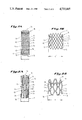
Schematic visualization of the patent's claim structure. Hand-drawn diagrams in progress for each landmark patent.
Where you've seen this
Real-world examples
Palmaz-Schatz stent
Balloon-expandable coronary stents
Balloon-expandable peripheral stents
Balloon-expandable vascular grafts
Why it matters
The bigger picture
This patent is a cornerstone for modern interventional cardiology, specifically for balloon-expandable stents. It provided the fundamental method and device concept that allowed doctors to treat blocked arteries without major open surgery. The technology described here enabled the widespread adoption of coronary stenting, significantly improving outcomes for patients with heart disease.
Filed
November 7, 1985
Granted
March 29, 1988
Market context
Who's building on this
Companies in this space
Major medical device companies like Medtronic, Abbott Laboratories, Boston Scientific, and Johnson & Johnson (through its Cordis division, which commercialized the Palmaz stent) have built extensive product lines based on balloon-expandable stent technology. Many startups also continue to innovate in this space, developing new materials and designs for these types of implants.
Market impact
This patent fundamentally changed the treatment of vascular disease. It enabled the development of the percutaneous coronary intervention (PCI) market, allowing for minimally invasive procedures to treat blocked arteries, which previously required open-heart surgery. This led to a massive reduction in recovery times and improved patient outcomes, creating a multi-billion dollar global market for stents and related delivery systems.
Claim 1 — Plain English
What this patent covers
This patent describes a method for implanting a medical device, called a prosthesis or intraluminal graft, inside a body passageway like a blood vessel. First, the prosthesis is placed onto a catheter (Claim 1). The catheter and prosthesis are then inserted into the body passageway (Claim 1). Once at the desired location, a part of the catheter, specifically an inflatable balloon (Claim 3), is expanded. This expansion forces the prosthesis outward, permanently deforming it beyond its elastic limit (Claim 1) to contact the walls of the passageway. The prosthesis, often a wire mesh tube made of tantalum (Claims 4, 5), then remains in place to prevent the passageway from collapsing (Claim 7). After expansion, the balloon is deflated, and the catheter is removed (Claim 2). For example, this method can be used to open a narrowed artery and keep it wide.
The clever bit
The key innovation was the idea of a graft that could be delivered in a collapsed state, then permanently expanded in situ by a balloon to a size determined by the body passageway, and critically, would stay expanded due to plastic deformation. This ensured the graft wouldn't migrate and would keep the vessel open.
What it does not cover
- Grafts that expand on their own without needing a balloon or other external force from the catheter.
- Grafts that are not permanently deformed when expanded, meaning they would spring back to their original size.
- Methods where the graft is expanded by a mechanism other than an inflatable portion of the catheter.
- Grafts that are not delivered upon a catheter but are instead injected or deployed differently.
- Grafts that are not tubular or made of intersecting elongate members, as described in Claim 13.
Patent timeline
Application submitted to the patent office
Application published, typically 18 months after filing
Patent officially issued
Patent enters public domain
This patent is in the public domain
See the Freedom to Build guide — what is free to use, what is not, and how to cite this patent.
PatentBrief Score
Impact Score
Strong
Citation count
40/40
Highly cited
Claim breadth
20/20
Very broad protection
Recency
0/20
Older than 20 years
Assignee scale
0/20
Independent or smaller assigneeassigneeThe entity that owns the patent — usually the inventor's employer or a company.Read more →
PatentBrief Impact Score — based on citation count, claim breadth, recency, and assignee scale. Not a legal assessment.
Heuristic Value Estimate
What this patent might be worth
$198K – $634K
Midpoint $396K · expired or expiring · industry ×2.2
Heuristic only — blends forward/backward citation counts, claim scope, time remaining, litigation history, and CPC-derived industry baseline. Real valuations need a professional appraisal.
Claim text not yet imported for this patent
The original legal language
Original claims
34 claims as filed with the patent office.
Concepts involved
Citations
Patent lineage
Cite this patent
Palmaz, J. C. (1988). How Doctors Implant a Permanent Stent Using a Balloon (U.S. Patent No. 4,733,665). U.S. Patent and Trademark Office. https://patentbrief.org/patent/us/4733665/palmaz-balloon-expandable-stent
Auto-generated from the patent record. Double-check author order and the issue date against the official USPTO document before submitting.
Embed
Add this patent to your site
Drop this plain-English patent card into any blog post or article — free, no signup. It always links back to the full breakdown here.
<div data-patentlens-widget data-patent-number="US4733665"></div>
<script src="https://patentbrief.org/embed.js" async></script>
Stay in the loop
Get a weekly digest of new patents.
One email per week. No spam. Unsubscribe anytime.
Keep exploring
Related patents you should know
US 4683195 · 1987
How to Make Billions of Copies of a DNA Segment
This patent describes the Polymerase Chain Reaction (PCR), a method to rapidly create many copies of a specific piece of DNA or RNA, enabling its detection and analysis.
Cetus Corp
US 8697359 · 2014
How to Edit Genes in Human Cells Using an Engineered CRISPR System
This patent describes an engineered CRISPR-Cas9 system for precisely cutting DNA in eukaryotic cells to change how genes work, opening the door for gene editing in complex organisms.
Massachusetts Institute of Technology
US 7657849 · 2010
How the iPhone's Slide-to-Unlock Gesture Works
Apple's 2010 patent describes unlocking a device by dragging a specific graphical image across the touchscreen along a predefined path, a gesture that became iconic with the original iPhone.
Apple Inc
US 4965188 · 1990
How to Make Many Copies of a DNA Piece with Heat
This patent describes the Polymerase Chain Reaction (PCR) method, a technique to make millions of copies of a specific DNA segment using a heat-resistant enzyme and repeated temperature changes.
Cetus Corp
US 4235871 · 1980
How to Encapsulate Active Materials in Lipid Bubbles Efficiently
This patent describes a method for trapping biologically active substances inside tiny, multi-layered fat bubbles called liposomes, using a specific water-in-oil emulsion and gel-forming process to improve how much material gets captured.
Individual
US 4405829 · 1983
How RSA Public-Key Encryption Keeps Digital Messages Secret
This patent describes the foundational RSA algorithm, a method for securely sending messages where anyone can encrypt a message using a public key, but only the intended recipient can decrypt it using a secret private key.
Massachusetts Institute of Technology
Semantically similar
You might also find these interesting
US 4195637 · 1980 · Schneider Medintag AG
Catheter System for Opening and Closing Body Passages
US 3057356 · 1962 · Wilson Greatbatch Technologies Inc
The First Implantable Cardiac Pacemaker
US 3614954 · 1971 · Medtronic Inc
How the First Automatic Implantable Defibrillator Works
US RE48750 · 2021 · Scimed Life Systems Inc
How Surgical Robots Create Working Space Inside the Body
More to explore
More in Biotech & Medicine
US 4683195 · 1987 · Cetus Corp
How to Make Billions of Copies of a DNA Segment
US 8697359 · 2014 · Massachusetts Institute of Technology
How to Edit Genes in Human Cells Using an Engineered CRISPR System
US 4965188 · 1990 · Cetus Corp
How to Make Many Copies of a DNA Piece with Heat
US 4235871 · 1980
How to Encapsulate Active Materials in Lipid Bubbles Efficiently
New to patents?
Common Questions
Frequently Asked Questions
What does How Doctors Implant a Permanent Stent Using a Balloon cover?
This patent describes the method for placing a permanent, expandable wire mesh tube inside a blood vessel or other body tube using a balloon-tipped catheter to widen it and keep it open.
Who owns patent US 4733665?
Expandable Grafts Partnership owns this patent, granted in 1988.
When does this patent expire?
This patent has expired and is now in the public domain — anyone can use the invention freely.
What is patent US 4733665 cited by?
This patent has been cited by 2425 later patents that build on its ideas.
What problem does this patent solve?
This patent is a cornerstone for modern interventional cardiology, specifically for balloon-expandable stents. It provided the fundamental method and device concept that allowed doctors to treat blocked arteries without major open surgery. The technology described here enabled the widespread adoption of coronary stenting, significantly improving outcomes for patients with heart disease.
What does this patent NOT cover?
Grafts that expand on their own without needing a balloon or other external force from the catheter.
Patent monitoring