How Drones Relay Signals Between a Base Station and a Working Drone
This patent describes a system where one or more unmanned aerial vehicles (relay drones) act as communication links, extending the range and improving signal quality between a ground control station and another drone or device.
Original patent title: “Relay drone system”
This patent describes a system where one or more unmanned aerial vehicles (relay drones) act as communication links, extending the range and improving signal quality between a ground control station and another drone or device. Granted to Pinnacle Vista in 2017 with 28 claims and 40 forward citations, and it is expected to expire in 2037.
Coverage
What does this patent actually cover?
The patent describes a system for extending communication range using at least one "relay drone." This relay drone maintains an "unobstructed straight line" (ClaimclaimA numbered sentence at the end of a patent that legally defines what the inventor owns. The most important section.Read more → 1) to both a base station and a "working drone." Its job is to receive control signals from the base station and pass them to the working drone, and similarly, receive data from the working drone and pass it back to the base station. For instance, if a base station needs to control a working drone inspecting a tall structure, but a building blocks the direct signal, a relay drone could hover between them, ensuring a clear communication path and boosting the signal. The system can use multiple relay drones (Claim 2) or even a single relay drone with multiple directional antennas to communicate with several working drones (Claim 18). The relay drone can also be tethered to the base station (Claim 4).
The gap
What does this patent NOT cover?
- A system where the base station has a direct, unobstructed line of sight to the working drone (ClaimclaimA numbered sentence at the end of a patent that legally defines what the inventor owns. The most important section.Read more → 12 implies the relay is needed because there isn't one).
- Relay communication systems that do not use drones as the relay nodes.
- Relay drones that are fixed-wing aircraft (ClaimclaimA numbered sentence at the end of a patent that legally defines what the inventor owns. The most important section.Read more → 13 states "not a fixed wing drone").
- A system where the relay drone does not pass both control signals to the working drone and data signals back to the base station (ClaimclaimA numbered sentence at the end of a patent that legally defines what the inventor owns. The most important section.Read more → 1).
- A relay drone that does not maintain an unobstructed straight line to both the base station and the working drone (ClaimclaimA numbered sentence at the end of a patent that legally defines what the inventor owns. The most important section.Read more → 1).
These exclusions are unique to PatentBrief — derived from the actual claim language, not patent-office boilerplate.
Key facts
What made this novel
The core innovation is the specific configuration of a drone acting as a dynamic, mobile communication relay that actively maintains an unobstructed line of sight between a ground station and a distant or obstructed working drone, rather than relying on fixed infrastructure. The patent also highlights using specific antenna types (directional, omnidirectional) for different communication tasks.
The Patent Drawing
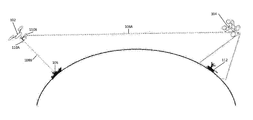
Schematic visualization of the patent's claim structure. Hand-drawn diagrams in progress for each landmark patent.
Where you've seen this
Real-world examples
Drone delivery services operating beyond visual line of sight.
Industrial inspection drones surveying large facilities or remote pipelines.
Search and rescue drones in urban or mountainous areas.
Military reconnaissance drones operating over varied terrain.
Tethered drones providing persistent communication links for disaster response.
Why it matters
The bigger picture
This technology is important for extending the operational range of drones, especially in complex environments where direct line-of-sight communication is difficult or impossible. It enables applications like long-range inspections, search and rescue operations over varied terrain, or maintaining control of drones operating behind obstacles. By improving signal reliability, it makes drone operations safer and more effective for various commercial and governmental uses.
Filed
May 5, 2017
Granted
December 5, 2017
Market context
Who's building on this
Companies in this space
Companies like DJI, Skydio, and Parrot are continuously developing drone communication and control systems to extend range and reliability. Telecommunications companies are also exploring drone-based relays for temporary network coverage. Startups focusing on drone infrastructure and beyond visual line of sight (BVLOS) operations are also active in this space.
Market impact
This patent addresses a fundamental challenge in drone operations: limited communication range and reliability, especially in complex environments. Its principles enable the expansion of drone applications into areas previously inaccessible due to signal constraints, fostering growth in drone services for inspection, delivery, and security. While not creating a new market, it significantly enhances the capabilities and safety of existing and emerging drone-based services.
Claim 1 — Plain English
What this patent covers
The patent describes a system for extending communication range using at least one "relay drone." This relay drone maintains an "unobstructed straight line" (Claim 1) to both a base station and a "working drone." Its job is to receive control signals from the base station and pass them to the working drone, and similarly, receive data from the working drone and pass it back to the base station. For instance, if a base station needs to control a working drone inspecting a tall structure, but a building blocks the direct signal, a relay drone could hover between them, ensuring a clear communication path and boosting the signal. The system can use multiple relay drones (Claim 2) or even a single relay drone with multiple directional antennas to communicate with several working drones (Claim 18). The relay drone can also be tethered to the base station (Claim 4).
The clever bit
The core innovation is the specific configuration of a drone acting as a dynamic, mobile communication relay that actively maintains an unobstructed line of sight between a ground station and a distant or obstructed working drone, rather than relying on fixed infrastructure. The patent also highlights using specific antenna types (directional, omnidirectional) for different communication tasks.
What it does not cover
- A system where the base station has a direct, unobstructed line of sight to the working drone (Claim 12 implies the relay is needed because there isn't one).
- Relay communication systems that do not use drones as the relay nodes.
- Relay drones that are fixed-wing aircraft (Claim 13 states "not a fixed wing drone").
- A system where the relay drone does not pass both control signals to the working drone and data signals back to the base station (Claim 1).
- A relay drone that does not maintain an unobstructed straight line to both the base station and the working drone (Claim 1).
Patent timeline
Application submitted to the patent office
Application published, typically 18 months after filing
Patent officially issued
Patent enters public domain
PatentBrief Score
Impact Score
Strong
Citation count
32/40
Moderately cited
Claim breadth
19/20
Very broad protection
Recency
10/20
Granted 5–10 years ago
Assignee scale
0/20
Independent or smaller assigneeassigneeThe entity that owns the patent — usually the inventor's employer or a company.Read more →
PatentBrief Impact Score — based on citation count, claim breadth, recency, and assignee scale. Not a legal assessment.
Heuristic Value Estimate
What this patent might be worth
$219K – $702K
Midpoint $439K · 10.5 yr remaining · industry ×1.5
Heuristic only — blends forward/backward citation counts, claim scope, time remaining, litigation history, and CPC-derived industry baseline. Real valuations need a professional appraisal.
Claim text not yet imported for this patent
The original legal language
Original claims
28 claims as filed with the patent office.
Concepts involved
Citations
Patent lineage
Cite this patent
Tu, H. (2017). How Drones Relay Signals Between a Base Station and a Working Drone (U.S. Patent No. 9,836,049). U.S. Patent and Trademark Office. https://patentbrief.org/patent/us/9836049/relay-drone-system
Auto-generated from the patent record. Double-check author order and the issue date against the official USPTO document before submitting.
Embed
Add this patent to your site
Drop this plain-English patent card into any blog post or article — free, no signup. It always links back to the full breakdown here.
<div data-patentlens-widget data-patent-number="US9836049"></div>
<script src="https://patentbrief.org/embed.js" async></script>
Stay in the loop
Get a weekly digest of new patents.
One email per week. No spam. Unsubscribe anytime.
Keep exploring
Related patents you should know
US 4683195 · 1987
How to Make Billions of Copies of a DNA Segment
This patent describes the Polymerase Chain Reaction (PCR), a method to rapidly create many copies of a specific piece of DNA or RNA, enabling its detection and analysis.
Cetus Corp
US 8697359 · 2014
How to Edit Genes in Human Cells Using an Engineered CRISPR System
This patent describes an engineered CRISPR-Cas9 system for precisely cutting DNA in eukaryotic cells to change how genes work, opening the door for gene editing in complex organisms.
Massachusetts Institute of Technology
US 7657849 · 2010
How the iPhone's Slide-to-Unlock Gesture Works
Apple's 2010 patent describes unlocking a device by dragging a specific graphical image across the touchscreen along a predefined path, a gesture that became iconic with the original iPhone.
Apple Inc
US 4733665 · 1988
How Doctors Implant a Permanent Stent Using a Balloon
This patent describes the method for placing a permanent, expandable wire mesh tube inside a blood vessel or other body tube using a balloon-tipped catheter to widen it and keep it open.
Expandable Grafts Partnership
US 4965188 · 1990
How to Make Many Copies of a DNA Piece with Heat
This patent describes the Polymerase Chain Reaction (PCR) method, a technique to make millions of copies of a specific DNA segment using a heat-resistant enzyme and repeated temperature changes.
Cetus Corp
US 4235871 · 1980
How to Encapsulate Active Materials in Lipid Bubbles Efficiently
This patent describes a method for trapping biologically active substances inside tiny, multi-layered fat bubbles called liposomes, using a specific water-in-oil emulsion and gel-forming process to improve how much material gets captured.
Individual
Semantically similar
You might also find these interesting
US 10133281 · 2018 · Pinnacle Vista
How a Drone Can Fly Ahead of a Moving Vehicle
US 20180321681 · Pinnacle Vista
How a Drone Flies Ahead of a Moving Ground or Water Vehicle
US 10317904 · 2019 · Pinnacle Vista
How a Boat Guides Air and Underwater Drones for Data Collection
US 10707961 · 2020 · Space Systems Loral
High-Flying Aircraft Relays Satellite Internet to Ground Users
More to explore
More in Telecom & Wireless
US 5347632 · 1994 · Prodigy Services Co
Prodigy's System for Interactive Online Information and Shopping
US 3906166 · 1975 · Motorola Inc
How Early Cell Phones Handled Calls Across Different Towers
US 4063220 · 1977 · Xerox Corp
How Multiple Computers Share a Network Cable Without Crashing
US 4200770 · 1980 · Leland Stanford Junior University
How to Create a Secret Code Key Without Meeting First
New to patents?
Common Questions
Frequently Asked Questions
What does How Drones Relay Signals Between a Base Station and a Working Drone cover?
This patent describes a system where one or more unmanned aerial vehicles (relay drones) act as communication links, extending the range and improving signal quality between a ground control station and another drone or device.
Who owns patent US 9836049?
Pinnacle Vista owns this patent, granted in 2017.
When does this patent expire?
This patent is expected to expire on May 5, 2037, when the invention enters the public domain.
What is patent US 9836049 cited by?
This patent has been cited by 40 later patents that build on its ideas.
What problem does this patent solve?
This technology is important for extending the operational range of drones, especially in complex environments where direct line-of-sight communication is difficult or impossible. It enables applications like long-range inspections, search and rescue operations over varied terrain, or maintaining control of drones operating behind obstacles. By improving signal reliability, it makes drone operations safer and more effective for various commercial and governmental uses.
What does this patent NOT cover?
A system where the base station has a direct, unobstructed line of sight to the working drone (Claim 12 implies the relay is needed because there isn't one).
Same assignee
More from Pinnacle Vista
Patent monitoring