How the iRobot Roomba Automatically Cleans Floors Without Falling Down Stairs
A 2002 patent describing an autonomous floor-cleaning robot that uses sensors to navigate rooms, avoid cliffs like stairs, and sweep debris into a removable bin.
Original patent title: “Autonomous floor-cleaning robot”
A 2002 patent describing an autonomous floor-cleaning robot that uses sensors to navigate rooms, avoid cliffs like stairs, and sweep debris into a removable bin. Granted to iRobot Corp in 2005 with 7 claims and 215 forward citations, and it is now in the public domain.
Coverage
What does this patent actually cover?
This patent describes an autonomous robot that cleans floors by combining a motive system for movement, a vacuum, and a primary brush assembly. It features a side brush that reaches beyond the robot's main body to pull dirt into the cleaning path. The robot uses a sensor system, specifically a cliff detector, to identify stairs or ledges and prevent itself from falling. When a cliff is detected, the control system automatically adjusts the robot's speed and direction to escape the area and resume cleaning.
The gap
What does this patent NOT cover?
- Does not cover non-robotic manual vacuum cleaners or push-brooms.
- Does not cover cleaning systems that rely on external navigation markers or beacons installed in a room.
- Does not cover robots that use cameras or visual mapping (SLAM) to navigate, as this patent focuses on tactile and cliff sensors.
- Does not cover robots that utilize liquid-based mopping systems as their primary cleaning mechanism.
These exclusions are unique to PatentBrief — derived from the actual claim language, not patent-office boilerplate.
Key facts
What made this novel
The innovation lies in the integration of a side brush that extends beyond the chassis, combined with a control system that treats 'cliffs' as a distinct sensor event requiring a specific escape maneuver rather than just a standard obstacle.
The Patent Drawing
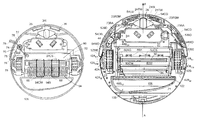
Schematic visualization of the patent's claim structure. Hand-drawn diagrams in progress for each landmark patent.
Where you've seen this
Real-world examples
Original iRobot Roomba models
Roomba 400 series
Early autonomous vacuum cleaners
Why it matters
The bigger picture
This patent is a foundational document for the modern consumer robotics industry. It established the core behavioral logic—such as the 'bounce' mode and cliff avoidance—that allowed the original iRobot Roomba to become a household staple. It effectively defined the 'bump-and-go' navigation style that dominated the market for over a decade.
Filed
December 16, 2002
Granted
April 26, 2005
Market context
Who's building on this
Companies in this space
iRobot remains the primary assigneeassigneeThe entity that owns the patent — usually the inventor's employer or a company.Read more → and continues to iterate on this architecture. However, competitors like Roborock, Ecovacs, and SharkNinja have built upon these foundational concepts, often adding advanced LiDAR and AI-based obstacle avoidance that goes beyond the basic tactile sensors described here.
Market impact
This patent helped launch the multi-billion dollar home robotics market. It provided a clear blueprint for reliable autonomous navigation in domestic environments, effectively creating the category of 'robotic vacuum cleaner' that forced traditional vacuum manufacturers to adapt or lose market share.
Claim 1 — Plain English
What this patent covers
This patent describes an autonomous robot that cleans floors by combining a motive system for movement, a vacuum, and a primary brush assembly. It features a side brush that reaches beyond the robot's main body to pull dirt into the cleaning path. The robot uses a sensor system, specifically a cliff detector, to identify stairs or ledges and prevent itself from falling. When a cliff is detected, the control system automatically adjusts the robot's speed and direction to escape the area and resume cleaning.
The clever bit
The innovation lies in the integration of a side brush that extends beyond the chassis, combined with a control system that treats 'cliffs' as a distinct sensor event requiring a specific escape maneuver rather than just a standard obstacle.
What it does not cover
- Does not cover non-robotic manual vacuum cleaners or push-brooms.
- Does not cover cleaning systems that rely on external navigation markers or beacons installed in a room.
- Does not cover robots that use cameras or visual mapping (SLAM) to navigate, as this patent focuses on tactile and cliff sensors.
- Does not cover robots that utilize liquid-based mopping systems as their primary cleaning mechanism.
Patent timeline
Application submitted to the patent office
Application published, typically 18 months after filing
Patent officially issued
Patent enters public domain
This patent is in the public domain
See the Freedom to Build guide — what is free to use, what is not, and how to cite this patent.
PatentBrief Score
Impact Score
Moderate
Citation count
40/40
Highly cited
Claim breadth
5/20
Moderate scope
Recency
0/20
Older than 20 years
Assignee scale
0/20
Independent or smaller assigneeassigneeThe entity that owns the patent — usually the inventor's employer or a company.Read more →
PatentBrief Impact Score — based on citation count, claim breadth, recency, and assignee scale. Not a legal assessment.
Heuristic Value Estimate
What this patent might be worth
$124K – $396K
Midpoint $248K · expired or expiring · industry ×2.2
Heuristic only — blends forward/backward citation counts, claim scope, time remaining, litigation history, and CPC-derived industry baseline. Real valuations need a professional appraisal.
Patent Claims
0 independent claims · 1 dependent
Claims are the legal boundaries of the patent. An independent claim stands alone. A dependent claim adds limitations to its parent, narrowing — but not broadening — the scope.
The original legal language
Original claims
7 claims as filed with the patent office.
Concepts involved
Citations
Patent lineage
Cite this patent
Sandin, P. E., Mack, N. E., Nugent, D. M., & Jones, J. L. (2005). How the iRobot Roomba Automatically Cleans Floors Without Falling Down Stairs (U.S. Patent No. 6,883,201). U.S. Patent and Trademark Office. https://patentbrief.org/patent/us/6883201/roomba-autonomous-vacuum
Auto-generated from the patent record. Double-check author order and the issue date against the official USPTO document before submitting.
Embed
Add this patent to your site
Drop this plain-English patent card into any blog post or article — free, no signup. It always links back to the full breakdown here.
<div data-patentlens-widget data-patent-number="US6883201"></div>
<script src="https://patentbrief.org/embed.js" async></script>
Stay in the loop
Get a weekly digest of new patents.
One email per week. No spam. Unsubscribe anytime.
Keep exploring
Related patents you should know
US 4683195 · 1987
How to Make Billions of Copies of a DNA Segment
This patent describes the Polymerase Chain Reaction (PCR), a method to rapidly create many copies of a specific piece of DNA or RNA, enabling its detection and analysis.
Cetus Corp
US 8697359 · 2014
How to Edit Genes in Human Cells Using an Engineered CRISPR System
This patent describes an engineered CRISPR-Cas9 system for precisely cutting DNA in eukaryotic cells to change how genes work, opening the door for gene editing in complex organisms.
Massachusetts Institute of Technology
US 7657849 · 2010
How the iPhone's Slide-to-Unlock Gesture Works
Apple's 2010 patent describes unlocking a device by dragging a specific graphical image across the touchscreen along a predefined path, a gesture that became iconic with the original iPhone.
Apple Inc
US 4733665 · 1988
How Doctors Implant a Permanent Stent Using a Balloon
This patent describes the method for placing a permanent, expandable wire mesh tube inside a blood vessel or other body tube using a balloon-tipped catheter to widen it and keep it open.
Expandable Grafts Partnership
US 4965188 · 1990
How to Make Many Copies of a DNA Piece with Heat
This patent describes the Polymerase Chain Reaction (PCR) method, a technique to make millions of copies of a specific DNA segment using a heat-resistant enzyme and repeated temperature changes.
Cetus Corp
US 4235871 · 1980
How to Encapsulate Active Materials in Lipid Bubbles Efficiently
This patent describes a method for trapping biologically active substances inside tiny, multi-layered fat bubbles called liposomes, using a specific water-in-oil emulsion and gel-forming process to improve how much material gets captured.
Individual
Semantically similar
You might also find these interesting
US 889823 · 1908
How James Spangler Invented the First Portable Electric Vacuum Cleaner
US 20220161815 · Intel
How Autonomous Cars Process Sensor Data for Driving
US 10733420 · 2020 · GM Global Technology Operations
How Self-Driving Cars Find Clear Paths Between Objects
US 20250170731 · Boston Dynamics
How Robots Figure Out What They're Carrying While Moving
More to explore
More in Consumer Electronics
US 7657849 · 2010 · Apple Inc
How the iPhone's Slide-to-Unlock Gesture Works
US 7479949 · 2009 · Apple Inc
How Touchscreens Understand Your Finger Swipes and Scrolls
US 4528643 · 1985 · FPDC Inc
How Stores Make Custom Products On-Demand with Remote Approval
US 7469381 · 2008 · Apple Inc
How Touchscreens Show and Snap Back When You Scroll Past an Edge
New to patents?
Common Questions
Frequently Asked Questions
What does How the iRobot Roomba Automatically Cleans Floors Without Falling Down Stairs cover?
A 2002 patent describing an autonomous floor-cleaning robot that uses sensors to navigate rooms, avoid cliffs like stairs, and sweep debris into a removable bin.
Who owns patent US 6883201?
iRobot Corp owns this patent, granted in 2005.
When does this patent expire?
This patent has expired and is now in the public domain — anyone can use the invention freely.
What is patent US 6883201 cited by?
This patent has been cited by 215 later patents that build on its ideas.
What problem does this patent solve?
This patent is a foundational document for the modern consumer robotics industry. It established the core behavioral logic—such as the 'bounce' mode and cliff avoidance—that allowed the original iRobot Roomba to become a household staple. It effectively defined the 'bump-and-go' navigation style that dominated the market for over a decade.
What does this patent NOT cover?
Does not cover non-robotic manual vacuum cleaners or push-brooms.
Patent monitoring