How a Portable Nuclear Reactor Stays Stable During Operation
This patent describes a small, portable nuclear fission reactor designed to be moved by ship, train, or truck, featuring a special internal design to keep its fuel and control rods stable and centered during operation.
Original patent title: “Small modular mobile fission reactor”
This patent describes a small, portable nuclear fission reactor designed to be moved by ship, train, or truck, featuring a special internal design to keep its fuel and control rods stable and centered during operation. Granted to BWXT Advanced Technologies in 2022 with 19 claims and 6 forward citations, and it is expected to expire in 2040.
Coverage
What does this patent actually cover?
This patent describes a "mobile, graphite-moderated fission reactor" (ClaimclaimA numbered sentence at the end of a patent that legally defines what the inventor owns. The most important section.Read more → 1) that is small enough to be transported by "ship, train or truck" (Claim 1). The reactor includes a "pressure vessel" that holds an "active core region" with "fuel assemblies" and "control systems" (Claim 1). A key part of the design involves "flow annulus features" (Claim 1), which are small structures attached to the inner surface of the cladding (the outer tube) around the fuel rods. These features are placed at different points along the rod's length and are rotationally offset from each other at successive points (Claim 1). This specific arrangement helps keep the fuel rods perfectly centered within their channels, ensuring stable operation by maintaining a consistent gap for coolant flow. For example, such a reactor could be built in a factory, loaded onto a flatbed truck, and driven to a remote location to provide power.
The gap
What does this patent NOT cover?
- Does not cover large, stationary nuclear power plants that are not designed for mobile transport.
- Does not cover reactors that are not specifically "graphite-moderated" (ClaimclaimA numbered sentence at the end of a patent that legally defines what the inventor owns. The most important section.Read more → 1).
- Does not cover mobile reactors that lack the specific "flow annulus features" for stabilizing fuel and control rods as described in ClaimclaimA numbered sentence at the end of a patent that legally defines what the inventor owns. The most important section.Read more → 1.
- Does not cover reactors where the "flow annulus features" are not rotationally offset at successive longitudinal locations (ClaimclaimA numbered sentence at the end of a patent that legally defines what the inventor owns. The most important section.Read more → 1).
- Does not cover reactors that are not sized for transport using a "ship, train or truck" (ClaimclaimA numbered sentence at the end of a patent that legally defines what the inventor owns. The most important section.Read more → 1).
These exclusions are unique to PatentBrief — derived from the actual claim language, not patent-office boilerplate.
Key facts
What made this novel
The clever bit is the specific design of the "flow annulus features," which are not just simple spacers. By distributing them circumferentially and then rotationally offsetting them at different points along the rod, the design ensures robust centering and stability of the fuel and control rods within their channels. This is crucial for safety and efficient heat transfer, especially in a reactor designed for mobility.
The Patent Drawing
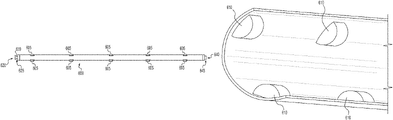
Schematic visualization of the patent's claim structure. Hand-drawn diagrams in progress for each landmark patent.
Where you've seen this
Real-world examples
BWXT Advanced Technologies microreactor designs
Other Small Modular Reactor (SMR) development projects
Future mobile power units for military or disaster relief
Deployable power solutions for remote mining or research outposts
Why it matters
The bigger picture
Small Modular Reactors (SMRs) are a growing area of interest for providing flexible, carbon-free power to remote locations, disaster relief efforts, or specialized industrial sites. This patent addresses a critical engineering challenge for such reactors: ensuring the stability and safety of the core components, like fuel and control rods, especially when the reactor is designed to be moved. By focusing on transportability and internal stability, it contributes to making SMRs a more viable option for diverse energy needs.
Filed
May 1, 2020
Granted
November 8, 2022
Market context
Who's building on this
Companies in this space
BWXT Advanced Technologies, the assigneeassigneeThe entity that owns the patent — usually the inventor's employer or a company.Read more →, is a major player in nuclear technologies, actively developing Small Modular Reactors (SMRs) and microreactors, including transportable systems. Other companies like Rolls-Royce SMR, NuScale Power, and TerraPower are also heavily invested in the broader SMR market, exploring various designs for deployable nuclear power solutions.
Market impact
This patent supports the emerging market for Small Modular Reactors (SMRs) by addressing a key engineering challenge for deployable nuclear power. By enabling safer and more stable operation of transportable reactors, it helps pave the way for SMRs to provide reliable, carbon-free energy to remote communities, industrial sites, and for specialized applications, potentially reducing reliance on fossil fuels in these areas.
Claim 1 — Plain English
What this patent covers
This patent describes a "mobile, graphite-moderated fission reactor" (Claim 1) that is small enough to be transported by "ship, train or truck" (Claim 1). The reactor includes a "pressure vessel" that holds an "active core region" with "fuel assemblies" and "control systems" (Claim 1). A key part of the design involves "flow annulus features" (Claim 1), which are small structures attached to the inner surface of the cladding (the outer tube) around the fuel rods. These features are placed at different points along the rod's length and are rotationally offset from each other at successive points (Claim 1). This specific arrangement helps keep the fuel rods perfectly centered within their channels, ensuring stable operation by maintaining a consistent gap for coolant flow. For example, such a reactor could be built in a factory, loaded onto a flatbed truck, and driven to a remote location to provide power.
The clever bit
The clever bit is the specific design of the "flow annulus features," which are not just simple spacers. By distributing them circumferentially and then rotationally offsetting them at different points along the rod, the design ensures robust centering and stability of the fuel and control rods within their channels. This is crucial for safety and efficient heat transfer, especially in a reactor designed for mobility.
What it does not cover
- Does not cover large, stationary nuclear power plants that are not designed for mobile transport.
- Does not cover reactors that are not specifically "graphite-moderated" (Claim 1).
- Does not cover mobile reactors that lack the specific "flow annulus features" for stabilizing fuel and control rods as described in Claim 1.
- Does not cover reactors where the "flow annulus features" are not rotationally offset at successive longitudinal locations (Claim 1).
- Does not cover reactors that are not sized for transport using a "ship, train or truck" (Claim 1).
Patent timeline
Application submitted to the patent office
Application published, typically 18 months after filing
Patent officially issued
Patent enters public domain
PatentBrief Score
Impact Score
Moderate
Citation count
17/40
Early citations
Claim breadth
13/20
Broad claimsclaimsThe numbered statements at the end of a patent that legally define what the inventor owns.Read more →
Recency
20/20
Granted within 5 years
Assignee scale
0/20
Independent or smaller assigneeassigneeThe entity that owns the patent — usually the inventor's employer or a company.Read more →
PatentBrief Impact Score — based on citation count, claim breadth, recency, and assignee scale. Not a legal assessment.
Heuristic Value Estimate
What this patent might be worth
$140K – $449K
Midpoint $281K · 13.6 yr remaining · industry ×1.5
Heuristic only — blends forward/backward citation counts, claim scope, time remaining, litigation history, and CPC-derived industry baseline. Real valuations need a professional appraisal.
Claim text not yet imported for this patent
The original legal language
Original claims
19 claims as filed with the patent office.
Concepts involved
Citations
Patent lineage
Cite this patent
GRAMLICH, C. D., & Russell, I. W. E. (2022). How a Portable Nuclear Reactor Stays Stable During Operation (U.S. Patent No. 11,495,363). U.S. Patent and Trademark Office. https://patentbrief.org/patent/us/11495363/small-modular-mobile-fission-reactor
Auto-generated from the patent record. Double-check author order and the issue date against the official USPTO document before submitting.
Embed
Add this patent to your site
Drop this plain-English patent card into any blog post or article — free, no signup. It always links back to the full breakdown here.
<div data-patentlens-widget data-patent-number="US11495363"></div>
<script src="https://patentbrief.org/embed.js" async></script>
Stay in the loop
Get a weekly digest of new patents.
One email per week. No spam. Unsubscribe anytime.
Keep exploring
Related patents you should know
US 4683195 · 1987
How to Make Billions of Copies of a DNA Segment
This patent describes the Polymerase Chain Reaction (PCR), a method to rapidly create many copies of a specific piece of DNA or RNA, enabling its detection and analysis.
Cetus Corp
US 8697359 · 2014
How to Edit Genes in Human Cells Using an Engineered CRISPR System
This patent describes an engineered CRISPR-Cas9 system for precisely cutting DNA in eukaryotic cells to change how genes work, opening the door for gene editing in complex organisms.
Massachusetts Institute of Technology
US 7657849 · 2010
How the iPhone's Slide-to-Unlock Gesture Works
Apple's 2010 patent describes unlocking a device by dragging a specific graphical image across the touchscreen along a predefined path, a gesture that became iconic with the original iPhone.
Apple Inc
US 4733665 · 1988
How Doctors Implant a Permanent Stent Using a Balloon
This patent describes the method for placing a permanent, expandable wire mesh tube inside a blood vessel or other body tube using a balloon-tipped catheter to widen it and keep it open.
Expandable Grafts Partnership
US 4965188 · 1990
How to Make Many Copies of a DNA Piece with Heat
This patent describes the Polymerase Chain Reaction (PCR) method, a technique to make millions of copies of a specific DNA segment using a heat-resistant enzyme and repeated temperature changes.
Cetus Corp
US 4235871 · 1980
How to Encapsulate Active Materials in Lipid Bubbles Efficiently
This patent describes a method for trapping biologically active substances inside tiny, multi-layered fat bubbles called liposomes, using a specific water-in-oil emulsion and gel-forming process to improve how much material gets captured.
Individual
Semantically similar
You might also find these interesting
US 11942229 · 2024 · BWXT Advanced Technologies
How a Molten Metal Buffer Improves Heat Transfer in Nuclear Reactors
US 11417435 · 2022 · GE Hitachi Nuclear Energy Americas
How a Nuclear Reactor's Rotating Drum Controls Power
US 10818403 · 2020 · Nuscale Power
How Nuclear Power Plants Reuse Fuel Between Multiple Reactors
US 12073952 · 2024 · BWXT Technical Services Group
Using Gas Pressure to Safely Control Liquid Fuel Nuclear Reactors
More to explore
More in Energy & Clean Tech
US RE49155 · 2022 · Halliburton Energy Services Inc
Electric or Natural Gas Blending and Pumping for Oil Wells
US 11436484 · 2022 · Nvidia Corp
Nvidia's Method for Training Self-Driving Car AI in Simulations
US 11840398 · 2023 · Titan Trailers Inc
How Titan Trailers Builds Stronger, Smoother Cargo Containers
US 2708656 · 1955
How the First Nuclear Reactor Works
New to patents?
Common Questions
Frequently Asked Questions
What does How a Portable Nuclear Reactor Stays Stable During Operation cover?
This patent describes a small, portable nuclear fission reactor designed to be moved by ship, train, or truck, featuring a special internal design to keep its fuel and control rods stable and centered during operation.
Who owns patent US 11495363?
BWXT Advanced Technologies owns this patent, granted in 2022.
When does this patent expire?
This patent is expected to expire on May 1, 2040, when the invention enters the public domain.
What is patent US 11495363 cited by?
This patent has been cited by 6 later patents that build on its ideas.
What problem does this patent solve?
Small Modular Reactors (SMRs) are a growing area of interest for providing flexible, carbon-free power to remote locations, disaster relief efforts, or specialized industrial sites. This patent addresses a critical engineering challenge for such reactors: ensuring the stability and safety of the core components, like fuel and control rods, especially when the reactor is designed to be moved. By focusing on transportability and internal stability, it contributes to making SMRs a more viable option for diverse energy needs.
What does this patent NOT cover?
Does not cover large, stationary nuclear power plants that are not designed for mobile transport.
Same assignee
More from BWXT Advanced Technologies
Patent monitoring