How the Modern Disposable Paper Cup Was Invented
A 1908 patent for a sanitary, single-use paper cup designed to prevent the spread of germs from shared public drinking vessels.
Original patent title: “Cup.”
A 1908 patent for a sanitary, single-use paper cup designed to prevent the spread of germs from shared public drinking vessels. Granted to Individual in 1912 with 4 forward citations, and it is now in the public domain.
Coverage
What does this patent actually cover?
The patent describes a drinking cup formed from a single piece of paper, folded into a conical or tapered shape. It uses a specific method of overlapping the edges and securing them to create a watertight seal without the need for adhesive that might taint the water. By creating a cheap, disposable vessel, it addressed the public health crisis of the early 20th century where shared metal cups at water coolers were spreading tuberculosis and other diseases.
The gap
What does this patent NOT cover?
- Does not cover cups made from materials other than paper or paper-based pulp.
- Does not cover reusable drinking vessels made of glass, metal, or ceramic.
- Does not cover the process of coating the paper with wax, which was a later improvement.
These exclusions are unique to PatentBrief — derived from the actual claim language, not patent-office boilerplate.
Key facts
What made this novel
The innovation was in the structural geometry of the paper fold, which allowed a flat sheet to become a rigid, leak-proof container using only mechanical pressure and folding, rather than complex manufacturing.
The Patent Drawing
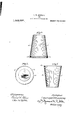
Schematic visualization of the patent's claim structure. Hand-drawn diagrams in progress for each landmark patent.
Where you've seen this
Real-world examples
Dixie Cups
Standard water cooler paper cones
Disposable coffee cup liners
Why it matters
The bigger picture
This invention effectively launched the modern disposable culture. It transformed public health by replacing communal dippers and glasses in schools and offices with individual, germ-free cups, directly contributing to the decline of waterborne illness transmission in public spaces.
Filed
May 23, 1908
Granted
July 16, 1912
Market context
Who's building on this
Companies in this space
Companies like Georgia-Pacific, which owns the Dixie brand, and various global packaging manufacturers continue to iterate on the material science of these cups, such as making them compostable or plastic-free.
Market impact
This patent triggered a massive shift in public health policy and consumer behavior, making the 'disposable' concept a standard in the food and beverage industry. It effectively killed the market for public communal drinking cups and created the multi-billion dollar single-use paper product industry.
Claim 1 — Plain English
What this patent covers
The patent describes a drinking cup formed from a single piece of paper, folded into a conical or tapered shape. It uses a specific method of overlapping the edges and securing them to create a watertight seal without the need for adhesive that might taint the water. By creating a cheap, disposable vessel, it addressed the public health crisis of the early 20th century where shared metal cups at water coolers were spreading tuberculosis and other diseases.
The clever bit
The innovation was in the structural geometry of the paper fold, which allowed a flat sheet to become a rigid, leak-proof container using only mechanical pressure and folding, rather than complex manufacturing.
What it does not cover
- Does not cover cups made from materials other than paper or paper-based pulp.
- Does not cover reusable drinking vessels made of glass, metal, or ceramic.
- Does not cover the process of coating the paper with wax, which was a later improvement.
Patent timeline
Application submitted to the patent office
Application published, typically 18 months after filing
Patent officially issued
Patent enters public domain
This patent is in the public domain
See the Freedom to Build guide — what is free to use, what is not, and how to cite this patent.
PatentBrief Score
Impact Score
Limited data
Citation count
14/40
Early citations
Claim breadth
0/20
Narrow claimsclaimsThe numbered statements at the end of a patent that legally define what the inventor owns.Read more →
Recency
0/20
Older than 20 years
Assignee scale
0/20
Independent or smaller assigneeassigneeThe entity that owns the patent — usually the inventor's employer or a company.Read more →
PatentBrief Impact Score — based on citation count, claim breadth, recency, and assignee scale. Not a legal assessment.
Heuristic Value Estimate
What this patent might be worth
$3K – $9K
Midpoint $5K · expired or expiring · industry ×0.9
Heuristic only — blends forward/backward citation counts, claim scope, time remaining, litigation history, and CPC-derived industry baseline. Real valuations need a professional appraisal.
Claim text not yet imported for this patent
Concepts involved
Citations
Patent lineage
Cite this patent
Luellen, L. W. (1912). How the Modern Disposable Paper Cup Was Invented (U.S. Patent No. 1,032,557). U.S. Patent and Trademark Office. https://patentbrief.org/patent/us/1032557/dixie-cup-disposable-paper-cup
Auto-generated from the patent record. Double-check author order and the issue date against the official USPTO document before submitting.
Embed
Add this patent to your site
Drop this plain-English patent card into any blog post or article — free, no signup. It always links back to the full breakdown here.
<div data-patentlens-widget data-patent-number="US1032557"></div>
<script src="https://patentbrief.org/embed.js" async></script>
Stay in the loop
Get a weekly digest of new patents.
One email per week. No spam. Unsubscribe anytime.
Keep exploring
Related patents you should know
US 4683195 · 1987
How to Make Billions of Copies of a DNA Segment
This patent describes the Polymerase Chain Reaction (PCR), a method to rapidly create many copies of a specific piece of DNA or RNA, enabling its detection and analysis.
Cetus Corp
US 8697359 · 2014
How to Edit Genes in Human Cells Using an Engineered CRISPR System
This patent describes an engineered CRISPR-Cas9 system for precisely cutting DNA in eukaryotic cells to change how genes work, opening the door for gene editing in complex organisms.
Massachusetts Institute of Technology
US 7657849 · 2010
How the iPhone's Slide-to-Unlock Gesture Works
Apple's 2010 patent describes unlocking a device by dragging a specific graphical image across the touchscreen along a predefined path, a gesture that became iconic with the original iPhone.
Apple Inc
US 4733665 · 1988
How Doctors Implant a Permanent Stent Using a Balloon
This patent describes the method for placing a permanent, expandable wire mesh tube inside a blood vessel or other body tube using a balloon-tipped catheter to widen it and keep it open.
Expandable Grafts Partnership
US 4965188 · 1990
How to Make Many Copies of a DNA Piece with Heat
This patent describes the Polymerase Chain Reaction (PCR) method, a technique to make millions of copies of a specific DNA segment using a heat-resistant enzyme and repeated temperature changes.
Cetus Corp
US 4235871 · 1980
How to Encapsulate Active Materials in Lipid Bubbles Efficiently
This patent describes a method for trapping biologically active substances inside tiny, multi-layered fat bubbles called liposomes, using a specific water-in-oil emulsion and gel-forming process to improve how much material gets captured.
Individual
Semantically similar
You might also find these interesting
US 375962 · 1888 · Marvin C. Stone
How the Modern Paper Drinking Straw Was Invented
US 775134 · 1904 · FED TRUST Co
How King Gillette Invented the Modern Disposable Safety Razor
US 468226 · 1892 · William Painter
How the Crown Cork Bottle Cap Changed Soda and Beer
US 3997676 · 1976 · Nissin Shokuhin KK
How Cup Noodles Are Designed to Cook Perfectly
More to explore
More in Consumer Electronics
US 7657849 · 2010 · Apple Inc
How the iPhone's Slide-to-Unlock Gesture Works
US 7479949 · 2009 · Apple Inc
How Touchscreens Understand Your Finger Swipes and Scrolls
US 4528643 · 1985 · FPDC Inc
How Stores Make Custom Products On-Demand with Remote Approval
US 7469381 · 2008 · Apple Inc
How Touchscreens Show and Snap Back When You Scroll Past an Edge
New to patents?
Common Questions
Frequently Asked Questions
What does How the Modern Disposable Paper Cup Was Invented cover?
A 1908 patent for a sanitary, single-use paper cup designed to prevent the spread of germs from shared public drinking vessels.
Who owns patent US 1032557?
Individual owns this patent, granted in 1912.
When does this patent expire?
This patent has expired and is now in the public domain — anyone can use the invention freely.
What is patent US 1032557 cited by?
This patent has been cited by 4 later patents that build on its ideas.
What problem does this patent solve?
This invention effectively launched the modern disposable culture. It transformed public health by replacing communal dippers and glasses in schools and offices with individual, germ-free cups, directly contributing to the decline of waterborne illness transmission in public spaces.
What does this patent NOT cover?
Does not cover cups made from materials other than paper or paper-based pulp.
Same assignee
More from Individual
Patent monitoring