How to Measure Stability in Complex Power Grids Using D-Q Impedance
A method for testing how electrical components in a power grid react to disturbances to ensure the grid remains stable and doesn't crash.
Original patent title: “Method for measuring D-Q impedance of polyphase power grid components”
A method for testing how electrical components in a power grid react to disturbances to ensure the grid remains stable and doesn't crash. Granted to Individual in 2011 with 16 claims and 7 forward citations, and it is expected to expire in 2029.
Coverage
What does this patent actually cover?
This patent describes a way to measure the 'D-Q impedance' of electrical components in a power grid, which helps engineers understand how those components interact with the grid's stability. It uses a generator as a probe, injecting specific 'suppressed-carrier' signals into the grid through its speed and field inputs. By measuring how the grid's voltage and current respond to these signals, the system solves a set of four simultaneous equations to calculate the D-Q impedance parameters (Zqq, Zqd, Zdq, and Zdd). These parameters allow engineers to create Nyquist diagrams, which are visual tools used to check if a power system is stable or prone to dangerous oscillations.
The gap
What does this patent NOT cover?
- Does not cover measuring impedance using external hardware probes or non-generator stimulus sources.
- Does not cover standard steady-state impedance measurements that do not utilize D-Q coordinate transformations.
- Does not cover stability analysis methods that do not rely on the specific four-equation resolution process described.
- Does not cover grid components that cannot be stimulated via speed or field excitation inputs.
These exclusions are unique to PatentBrief — derived from the actual claim language, not patent-office boilerplate.
Key facts
What made this novel
Instead of building a separate, expensive testing device, the method turns an existing generator into a precision instrument by using its own control inputs (speed and field) to 'ping' the grid and measure the response.
The Patent Drawing
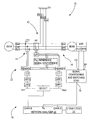
Schematic visualization of the patent's claim structure. Hand-drawn diagrams in progress for each landmark patent.
Where you've seen this
Real-world examples
Utility-scale power grid stability testing
Wind farm integration analysis
Large-scale synchronous generator performance monitoring
Why it matters
The bigger picture
Modern power grids are increasingly complex due to the integration of renewable energy sources and power electronics, which can cause unpredictable interactions. This method provides a systematic way to diagnose potential instability before it leads to equipment damage or blackouts. It is particularly relevant for utility-scale grid operators who need to ensure that new hardware, like wind or solar farms, will play nicely with existing infrastructure.
Filed
March 23, 2009
Granted
October 25, 2011
Market context
Who's building on this
Companies in this space
Large power equipment manufacturers like Siemens, GE Vernova, and ABB utilize similar concepts of small-signal stability analysis and impedance-based modeling to certify grid-connected hardware. These companies rely on these mathematical frameworks to ensure that power converters do not cause sub-synchronous oscillations in the grid.
Market impact
This patent formalizes a diagnostic approach that has become increasingly critical as grids move away from purely passive, rotating-mass-based systems toward active, inverter-dominated systems. It provides a standardized framework for stability verification, which is now a common requirement in grid interconnection studies for new power plants.
Claim 1 — Plain English
What this patent covers
This patent describes a way to measure the 'D-Q impedance' of electrical components in a power grid, which helps engineers understand how those components interact with the grid's stability. It uses a generator as a probe, injecting specific 'suppressed-carrier' signals into the grid through its speed and field inputs. By measuring how the grid's voltage and current respond to these signals, the system solves a set of four simultaneous equations to calculate the D-Q impedance parameters (Zqq, Zqd, Zdq, and Zdd). These parameters allow engineers to create Nyquist diagrams, which are visual tools used to check if a power system is stable or prone to dangerous oscillations.
The clever bit
Instead of building a separate, expensive testing device, the method turns an existing generator into a precision instrument by using its own control inputs (speed and field) to 'ping' the grid and measure the response.
What it does not cover
- Does not cover measuring impedance using external hardware probes or non-generator stimulus sources.
- Does not cover standard steady-state impedance measurements that do not utilize D-Q coordinate transformations.
- Does not cover stability analysis methods that do not rely on the specific four-equation resolution process described.
- Does not cover grid components that cannot be stimulated via speed or field excitation inputs.
Patent timeline
Application submitted to the patent office
Application published, typically 18 months after filing
Patent officially issued
Patent enters public domain
PatentBrief Score
Impact Score
Early stage
Citation count
18/40
Early citations
Claim breadth
11/20
Broad claimsclaimsThe numbered statements at the end of a patent that legally define what the inventor owns.Read more →
Recency
5/20
Granted 10–20 years ago
Assignee scale
0/20
Independent or smaller assigneeassigneeThe entity that owns the patent — usually the inventor's employer or a company.Read more →
PatentBrief Impact Score — based on citation count, claim breadth, recency, and assignee scale. Not a legal assessment.
Heuristic Value Estimate
What this patent might be worth
$31K – $100K
Midpoint $62K · 2.5 yr remaining · industry ×1.5
Heuristic only — blends forward/backward citation counts, claim scope, time remaining, litigation history, and CPC-derived industry baseline. Real valuations need a professional appraisal.
Patent Claims
0 independent claims · 1 dependent
Claims are the legal boundaries of the patent. An independent claim stands alone. A dependent claim adds limitations to its parent, narrowing — but not broadening — the scope.
The original legal language
Original claims
16 claims as filed with the patent office.
Concepts involved
Citations
Patent lineage
Cite this patent
Williams, M. L. (2011). How to Measure Stability in Complex Power Grids Using D-Q Impedance (U.S. Patent No. 8,044,672). U.S. Patent and Trademark Office. https://patentbrief.org/patent/us/8044672/method-for-measuring-d-q-impedance-of-polyphase-power-grid-components
Auto-generated from the patent record. Double-check author order and the issue date against the official USPTO document before submitting.
Embed
Add this patent to your site
Drop this plain-English patent card into any blog post or article — free, no signup. It always links back to the full breakdown here.
<div data-patentlens-widget data-patent-number="US8044672"></div>
<script src="https://patentbrief.org/embed.js" async></script>
Stay in the loop
Get a weekly digest of new patents.
One email per week. No spam. Unsubscribe anytime.
Keep exploring
Related patents you should know
US 4683195 · 1987
How to Make Billions of Copies of a DNA Segment
This patent describes the Polymerase Chain Reaction (PCR), a method to rapidly create many copies of a specific piece of DNA or RNA, enabling its detection and analysis.
Cetus Corp
US 8697359 · 2014
How to Edit Genes in Human Cells Using an Engineered CRISPR System
This patent describes an engineered CRISPR-Cas9 system for precisely cutting DNA in eukaryotic cells to change how genes work, opening the door for gene editing in complex organisms.
Massachusetts Institute of Technology
US 7657849 · 2010
How the iPhone's Slide-to-Unlock Gesture Works
Apple's 2010 patent describes unlocking a device by dragging a specific graphical image across the touchscreen along a predefined path, a gesture that became iconic with the original iPhone.
Apple Inc
US 4733665 · 1988
How Doctors Implant a Permanent Stent Using a Balloon
This patent describes the method for placing a permanent, expandable wire mesh tube inside a blood vessel or other body tube using a balloon-tipped catheter to widen it and keep it open.
Expandable Grafts Partnership
US 4965188 · 1990
How to Make Many Copies of a DNA Piece with Heat
This patent describes the Polymerase Chain Reaction (PCR) method, a technique to make millions of copies of a specific DNA segment using a heat-resistant enzyme and repeated temperature changes.
Cetus Corp
US 4235871 · 1980
How to Encapsulate Active Materials in Lipid Bubbles Efficiently
This patent describes a method for trapping biologically active substances inside tiny, multi-layered fat bubbles called liposomes, using a specific water-in-oil emulsion and gel-forming process to improve how much material gets captured.
Individual
Semantically similar
You might also find these interesting
US 6552634 · 2003
Designing Electronic Networks for Efficient Power Amplification
US 11946452 · 2024 · University of Minnesota System
How Wind Turbines Adapt to Icy Weather to Keep Making Power
US 9985438 · 2018 · Electric Power Research Institute of State Grid Zhejiang Electric Power Co
Optimizing Power for Remote Grids with Diesel, Wind, Solar, and Batteries
US 10480867 · 2019 · Tsinghua University
Smart Energy System for Power, Heating, and Cooling Grids
More to explore
More in Energy & Clean Tech
US RE49155 · 2022 · Halliburton Energy Services Inc
Electric or Natural Gas Blending and Pumping for Oil Wells
US 11436484 · 2022 · Nvidia Corp
Nvidia's Method for Training Self-Driving Car AI in Simulations
US 11840398 · 2023 · Titan Trailers Inc
How Titan Trailers Builds Stronger, Smoother Cargo Containers
US 2708656 · 1955
How the First Nuclear Reactor Works
New to patents?
Common Questions
Frequently Asked Questions
What does How to Measure Stability in Complex Power Grids Using D-Q Impedance cover?
A method for testing how electrical components in a power grid react to disturbances to ensure the grid remains stable and doesn't crash.
Who owns patent US 8044672?
Individual owns this patent, granted in 2011.
When does this patent expire?
This patent is expected to expire on March 23, 2029, when the invention enters the public domain.
What is patent US 8044672 cited by?
This patent has been cited by 7 later patents that build on its ideas.
What problem does this patent solve?
Modern power grids are increasingly complex due to the integration of renewable energy sources and power electronics, which can cause unpredictable interactions. This method provides a systematic way to diagnose potential instability before it leads to equipment damage or blackouts. It is particularly relevant for utility-scale grid operators who need to ensure that new hardware, like wind or solar farms, will play nicely with existing infrastructure.
What does this patent NOT cover?
Does not cover measuring impedance using external hardware probes or non-generator stimulus sources.
Same assignee
More from Individual
Patent monitoring