Wind Turbine Blade Sleeve Design for Better Aerodynamics
This patent describes a specially shaped sleeve that fits onto the base of a wind turbine blade, improving airflow and performance.
Original patent title: “Root sleeve for wind turbine blade”
This patent describes a specially shaped sleeve that fits onto the base of a wind turbine blade, improving airflow and performance. Granted to General Electric in 2010 with 20 claims and 10 forward citations, and it is expected to expire in 2028.
Coverage
What does this patent actually cover?
This patent details a sleeve designed to fit over the root end of a wind turbine blade, where it connects to the hub. The sleeve has a rounded front edge and a sharp back edge, similar to an airplane wing's shape, to manage airflow. Crucially, its outer edge (the outboard edge) has a curved inward shape, called a concave planform, on one or both sides of the blade. This design helps control how air flows around the blade's base, especially as the blade pitches, potentially reducing drag and increasing efficiency. ClaimclaimA numbered sentence at the end of a patent that legally defines what the inventor owns. The most important section.Read more → 7 describes the sleeve as part of a larger wind turbine system, with a gap allowing air to move between the blade and the sleeve, and this gap adjusts during blade pitching.
The gap
What does this patent NOT cover?
- Sleeves that do not have a rounded leading edge and a sharp trailing edge.
- Sleeves where the outboard edge does not have a concave planform.
- Sleeves that are not designed to receive the root end of a wind turbine blade.
- Sleeves that do not have an inboard edge intended to abut a wind turbine hub.
- Wind turbine systems where the sleeve does not allow for a gap that adjusts during pitching.
These exclusions are unique to PatentBrief — derived from the actual claim language, not patent-office boilerplate.
Key facts
What made this novel
The key innovation is the specific shaping of the outboard edge with a concave planform. This detail, combined with the rounded leading and sharp trailing edges, is designed to optimize airflow management at the blade's base, an area often subject to complex aerodynamic interactions.
The Patent Drawing
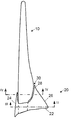
Schematic visualization of the patent's claim structure. Hand-drawn diagrams in progress for each landmark patent.
Where you've seen this
Real-world examples
Modern wind turbine designs
Components for large-scale wind farms
Why it matters
The bigger picture
Wind turbine efficiency is critical for renewable energy production. Innovations that improve aerodynamic performance, even at the blade root, can lead to significant gains in energy capture. This patent addresses a specific area of the blade that can influence overall performance and structural loads.
Filed
December 3, 2008
Granted
November 23, 2010
Market context
Who's building on this
Companies in this space
General Electric, the assigneeassigneeThe entity that owns the patent — usually the inventor's employer or a company.Read more →, is a major player in wind turbine technology. Other large manufacturers of wind turbines, such as Vestas, Siemens Gamesa, and Nordex, likely develop similar aerodynamic features for their blade designs, though they may use different patented approaches.
Market impact
This patent likely contributed to the ongoing refinement of wind turbine blade aerodynamics. By providing a specific design for the blade root sleeve, it may have influenced how manufacturers approach airflow management at this critical junction, potentially leading to incremental improvements in energy capture and reduced stress on turbine components.
Claim 1 — Plain English
What this patent covers
This patent details a sleeve designed to fit over the root end of a wind turbine blade, where it connects to the hub. The sleeve has a rounded front edge and a sharp back edge, similar to an airplane wing's shape, to manage airflow. Crucially, its outer edge (the outboard edge) has a curved inward shape, called a concave planform, on one or both sides of the blade. This design helps control how air flows around the blade's base, especially as the blade pitches, potentially reducing drag and increasing efficiency. Claim 7 describes the sleeve as part of a larger wind turbine system, with a gap allowing air to move between the blade and the sleeve, and this gap adjusts during blade pitching.
The clever bit
The key innovation is the specific shaping of the outboard edge with a concave planform. This detail, combined with the rounded leading and sharp trailing edges, is designed to optimize airflow management at the blade's base, an area often subject to complex aerodynamic interactions.
What it does not cover
- Sleeves that do not have a rounded leading edge and a sharp trailing edge.
- Sleeves where the outboard edge does not have a concave planform.
- Sleeves that are not designed to receive the root end of a wind turbine blade.
- Sleeves that do not have an inboard edge intended to abut a wind turbine hub.
- Wind turbine systems where the sleeve does not allow for a gap that adjusts during pitching.
Patent timeline
Application submitted to the patent office
Application published, typically 18 months after filing
Patent officially issued
Patent enters public domain
PatentBrief Score
Impact Score
Moderate
Citation count
21/40
Early citations
Claim breadth
13/20
Broad claimsclaimsThe numbered statements at the end of a patent that legally define what the inventor owns.Read more →
Recency
5/20
Granted 10–20 years ago
Assignee scale
20/20
Major company or institution
PatentBrief Impact Score — based on citation count, claim breadth, recency, and assignee scale. Not a legal assessment.
Heuristic Value Estimate
What this patent might be worth
$25K – $80K
Midpoint $50K · 2.0 yr remaining · industry baseline
Heuristic only — blends forward/backward citation counts, claim scope, time remaining, litigation history, and CPC-derived industry baseline. Real valuations need a professional appraisal.
Patent Claims
1 independent claim · 0 dependent
Claims are the legal boundaries of the patent. An independent claim stands alone. A dependent claim adds limitations to its parent, narrowing — but not broadening — the scope.
The original legal language
Original claims
20 claims as filed with the patent office.
Concepts involved
Citations
Patent lineage
Cite this patent
Heinze, W. F., Herr, S., & Kirtley, K. R. (2010). Wind Turbine Blade Sleeve Design for Better Aerodynamics (U.S. Patent No. 7,837,442). U.S. Patent and Trademark Office. https://patentbrief.org/patent/us/7837442/root-sleeve-for-wind-turbine-blade
Auto-generated from the patent record. Double-check author order and the issue date against the official USPTO document before submitting.
Embed
Add this patent to your site
Drop this plain-English patent card into any blog post or article — free, no signup. It always links back to the full breakdown here.
<div data-patentlens-widget data-patent-number="US7837442"></div>
<script src="https://patentbrief.org/embed.js" async></script>
Stay in the loop
Get a weekly digest of new patents.
One email per week. No spam. Unsubscribe anytime.
Keep exploring
Related patents you should know
US 4683195 · 1987
How to Make Billions of Copies of a DNA Segment
This patent describes the Polymerase Chain Reaction (PCR), a method to rapidly create many copies of a specific piece of DNA or RNA, enabling its detection and analysis.
Cetus Corp
US 8697359 · 2014
How to Edit Genes in Human Cells Using an Engineered CRISPR System
This patent describes an engineered CRISPR-Cas9 system for precisely cutting DNA in eukaryotic cells to change how genes work, opening the door for gene editing in complex organisms.
Massachusetts Institute of Technology
US 7657849 · 2010
How the iPhone's Slide-to-Unlock Gesture Works
Apple's 2010 patent describes unlocking a device by dragging a specific graphical image across the touchscreen along a predefined path, a gesture that became iconic with the original iPhone.
Apple Inc
US 4733665 · 1988
How Doctors Implant a Permanent Stent Using a Balloon
This patent describes the method for placing a permanent, expandable wire mesh tube inside a blood vessel or other body tube using a balloon-tipped catheter to widen it and keep it open.
Expandable Grafts Partnership
US 4965188 · 1990
How to Make Many Copies of a DNA Piece with Heat
This patent describes the Polymerase Chain Reaction (PCR) method, a technique to make millions of copies of a specific DNA segment using a heat-resistant enzyme and repeated temperature changes.
Cetus Corp
US 4235871 · 1980
How to Encapsulate Active Materials in Lipid Bubbles Efficiently
This patent describes a method for trapping biologically active substances inside tiny, multi-layered fat bubbles called liposomes, using a specific water-in-oil emulsion and gel-forming process to improve how much material gets captured.
Individual
Semantically similar
You might also find these interesting
US 7614852 · 2009
Wind Turbine Blades with a Deeply Curved Front Surface
US 8303250 · 2012 · General Electric
How Wind Turbine Blades Get More Lift with Extra Parts
US 8801387 · 2014 · Mitsubishi Heavy Industries
How a Wind Turbine Blade's Tip Shape Reduces Noise and Improves Airflow
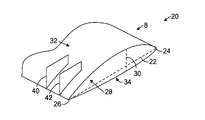
US 7927078 · 2011 · General Electric
How Wind Turbine Blades Reduce Noise with Small Fins
More to explore
More in Energy & Clean Tech
US RE49155 · 2022 · Halliburton Energy Services Inc
Electric or Natural Gas Blending and Pumping for Oil Wells
US 11436484 · 2022 · Nvidia Corp
Nvidia's Method for Training Self-Driving Car AI in Simulations
US 11840398 · 2023 · Titan Trailers Inc
How Titan Trailers Builds Stronger, Smoother Cargo Containers
US 2708656 · 1955
How the First Nuclear Reactor Works
New to patents?
Common Questions
Frequently Asked Questions
What does Wind Turbine Blade Sleeve Design for Better Aerodynamics cover?
This patent describes a specially shaped sleeve that fits onto the base of a wind turbine blade, improving airflow and performance.
Who owns patent US 7837442?
General Electric owns this patent, granted in 2010.
When does this patent expire?
This patent is expected to expire on December 3, 2028, when the invention enters the public domain.
What is patent US 7837442 cited by?
This patent has been cited by 10 later patents that build on its ideas.
What problem does this patent solve?
Wind turbine efficiency is critical for renewable energy production. Innovations that improve aerodynamic performance, even at the blade root, can lead to significant gains in energy capture. This patent addresses a specific area of the blade that can influence overall performance and structural loads.
What does this patent NOT cover?
Sleeves that do not have a rounded leading edge and a sharp trailing edge.
Same assignee
More from General Electric
Patent monitoring