Securely Analyzing Mixed Data with Distributed AI and Privacy
This patent describes a method for securely analyzing different types of data, like images and text, across multiple computers without collecting all the data in one place, while also protecting privacy.
Original patent title: “Federated mining method and system for multimodal data based on multiple security policies”
This patent describes a method for securely analyzing different types of data, like images and text, across multiple computers without collecting all the data in one place, while also protecting privacy. Owned by Xuzhou Medical College with 6 claims and 14 forward citations, and it is expected to expire in 2044.
Coverage
What does this patent actually cover?
This patent outlines a method for analyzing diverse data, known as multimodal data, using a distributed approach called federated learning (S1). It sets up a system where multiple computers, called local edge nodes, can work together on data without sharing the raw information. Before participating, each node undergoes a 'multiple authentication mechanism' (S2), which includes a lightweight trusted verification using a random forest model and a calculation of its 'local model reputation' based on its F1_score and error rate. The system then performs 'multimodal data fusion' and 'multimodal data classification' on the combined dataset using a 'generalized multimodal data feature fusion model' that relies on a 'multi-head attention mechanism' (S3). This mechanism involves extracting features (e.g., 3D-CNN for images, OpenSmile for audio, Word2Vec for text), splicing them, calculating correlation scores, and using these scores to weight and sum representations for fusion and dimensionality reduction. Finally, an 'adaptive perturbation mechanism' (S4) adds noise dynamically to protect privacy, using cyclic correlation analysis and differential privacy with Gaussian noise.
The gap
What does this patent NOT cover?
- Does not cover data mining systems that collect all raw data into a central location before processing.
- Does not cover systems that rely on only a single method for verifying the trustworthiness of participating data nodes.
- Does not cover analysis of data that consists of only one type, such as just images or just audio.
- Does not cover privacy protection methods that add noise without dynamically adjusting it based on data correlations and differential privacy.
- Does not cover data fusion models that do not specifically use a multi-head attention mechanism for combining different data types.
These exclusions are unique to PatentBrief — derived from the actual claim language, not patent-office boilerplate.
Key facts
What made this novel
The clever bit is combining federated learning with a robust, multi-layered security and privacy framework specifically designed for multimodal data. This includes not just authenticating nodes, but also evaluating their 'reputation' and dynamically adding noise to protect privacy based on data correlations, ensuring both collaboration and data confidentiality.
The Patent Drawing
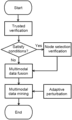
Schematic visualization of the patent's claim structure. Hand-drawn diagrams in progress for each landmark patent.
Where you've seen this
Real-world examples
Medical diagnostic systems analyzing patient images, audio, and text notes from different hospitals.
Smart city applications processing sensor data, video feeds, and text reports from various city departments.
Industrial IoT platforms combining machine sensor data, maintenance logs, and operator voice commands.
Personalized health monitoring apps analyzing wearable data, user input, and environmental factors.
Why it matters
The bigger picture
This technology is important because it allows powerful AI models to learn from sensitive data, like medical records, without compromising patient privacy. By keeping data localized and only sharing model updates, it addresses critical concerns in industries with strict data regulations. This approach can accelerate the development of AI applications in fields where data sharing is otherwise difficult or impossible.
Filed
December 30, 2024
Market context
Who's building on this
Companies in this space
Major technology companies like Google, NVIDIA, and IBM are actively developing federated learning platforms and tools, often with a focus on secure AI and privacy-preserving machine learning. Startups in the healthcare AI space are particularly interested in these methods to unlock insights from distributed medical data. Xuzhou Medical College, the assigneeassigneeThe entity that owns the patent — usually the inventor's employer or a company.Read more →, likely focuses on applying this technology to medical research and clinical applications.
Market impact
This type of technology addresses a significant market need for privacy-preserving AI, especially in highly regulated sectors like healthcare and finance. It enables collaborative AI model training across organizations without direct data sharing, fostering innovation while maintaining data sovereignty. This can lead to new product lines in secure data analytics and accelerate the adoption of AI in sensitive domains, potentially reducing legal and ethical barriers to AI development.
Claim 1 — Plain English
What this patent covers
This patent outlines a method for analyzing diverse data, known as multimodal data, using a distributed approach called federated learning (S1). It sets up a system where multiple computers, called local edge nodes, can work together on data without sharing the raw information. Before participating, each node undergoes a 'multiple authentication mechanism' (S2), which includes a lightweight trusted verification using a random forest model and a calculation of its 'local model reputation' based on its F1_score and error rate. The system then performs 'multimodal data fusion' and 'multimodal data classification' on the combined dataset using a 'generalized multimodal data feature fusion model' that relies on a 'multi-head attention mechanism' (S3). This mechanism involves extracting features (e.g., 3D-CNN for images, OpenSmile for audio, Word2Vec for text), splicing them, calculating correlation scores, and using these scores to weight and sum representations for fusion and dimensionality reduction. Finally, an 'adaptive perturbation mechanism' (S4) adds noise dynamically to protect privacy, using cyclic correlation analysis and differential privacy with Gaussian noise.
The clever bit
The clever bit is combining federated learning with a robust, multi-layered security and privacy framework specifically designed for multimodal data. This includes not just authenticating nodes, but also evaluating their 'reputation' and dynamically adding noise to protect privacy based on data correlations, ensuring both collaboration and data confidentiality.
What it does not cover
- Does not cover data mining systems that collect all raw data into a central location before processing.
- Does not cover systems that rely on only a single method for verifying the trustworthiness of participating data nodes.
- Does not cover analysis of data that consists of only one type, such as just images or just audio.
- Does not cover privacy protection methods that add noise without dynamically adjusting it based on data correlations and differential privacy.
- Does not cover data fusion models that do not specifically use a multi-head attention mechanism for combining different data types.
Patent timeline
Application submitted to the patent office
Patent enters public domain
PatentBrief Score
Impact Score
Moderate
Citation count
23/40
Moderately cited
Claim breadth
4/20
Moderate scope
Recency
0/20
Older than 20 years
Assignee scale
20/20
Major company or institution
PatentBrief Impact Score — based on citation count, claim breadth, recency, and assignee scale. Not a legal assessment.
Heuristic Value Estimate
What this patent might be worth
$92K – $295K
Midpoint $184K · 18.2 yr remaining · industry ×1.6
Heuristic only — blends forward/backward citation counts, claim scope, time remaining, litigation history, and CPC-derived industry baseline. Real valuations need a professional appraisal.
Claim text not yet imported for this patent
The original legal language
Original claims
6 claims as filed with the patent office.
Concepts involved
Citations
Patent lineage
Cite this patent
Wang, L., LU, C., Wu, X., HU, D., & ZHANG, Y. Securely Analyzing Mixed Data with Distributed AI and Privacy (U.S. Patent No. 20,250,184,362). U.S. Patent and Trademark Office. https://patentbrief.org/patent/us/20250184362/federated-mining-method-and-system-for-multimodal-data-based-on-multiple-securit
Auto-generated from the patent record. Double-check author order and the issue date against the official USPTO document before submitting.
Embed
Add this patent to your site
Drop this plain-English patent card into any blog post or article — free, no signup. It always links back to the full breakdown here.
<div data-patentlens-widget data-patent-number="US20250184362"></div>
<script src="https://patentbrief.org/embed.js" async></script>
Stay in the loop
Get a weekly digest of new patents.
One email per week. No spam. Unsubscribe anytime.
Keep exploring
Related patents you should know
US 4683195 · 1987
How to Make Billions of Copies of a DNA Segment
This patent describes the Polymerase Chain Reaction (PCR), a method to rapidly create many copies of a specific piece of DNA or RNA, enabling its detection and analysis.
Cetus Corp
US 8697359 · 2014
How to Edit Genes in Human Cells Using an Engineered CRISPR System
This patent describes an engineered CRISPR-Cas9 system for precisely cutting DNA in eukaryotic cells to change how genes work, opening the door for gene editing in complex organisms.
Massachusetts Institute of Technology
US 7657849 · 2010
How the iPhone's Slide-to-Unlock Gesture Works
Apple's 2010 patent describes unlocking a device by dragging a specific graphical image across the touchscreen along a predefined path, a gesture that became iconic with the original iPhone.
Apple Inc
US 4733665 · 1988
How Doctors Implant a Permanent Stent Using a Balloon
This patent describes the method for placing a permanent, expandable wire mesh tube inside a blood vessel or other body tube using a balloon-tipped catheter to widen it and keep it open.
Expandable Grafts Partnership
US 4965188 · 1990
How to Make Many Copies of a DNA Piece with Heat
This patent describes the Polymerase Chain Reaction (PCR) method, a technique to make millions of copies of a specific DNA segment using a heat-resistant enzyme and repeated temperature changes.
Cetus Corp
US 4235871 · 1980
How to Encapsulate Active Materials in Lipid Bubbles Efficiently
This patent describes a method for trapping biologically active substances inside tiny, multi-layered fat bubbles called liposomes, using a specific water-in-oil emulsion and gel-forming process to improve how much material gets captured.
Individual
Semantically similar
You might also find these interesting
US 11853891 · 2023 · Sharecare AI
How AI Models Learn from Your Health Data Without Sharing It

US 12626144 · 2026 · Huawei Technologies Co
How Devices Securely Share Machine Learning Model Updates

US 12518214 · 2026 · Nant Holdings IP
Training AI on Private Data Without Seeing It

US 12443890 · 2025 · Google
How Devices Train Shared AI Models While Keeping Your Data Private
More to explore
More in Biotech & Medicine
US 4683195 · 1987 · Cetus Corp
How to Make Billions of Copies of a DNA Segment
US 8697359 · 2014 · Massachusetts Institute of Technology
How to Edit Genes in Human Cells Using an Engineered CRISPR System
US 4733665 · 1988 · Expandable Grafts Partnership
How Doctors Implant a Permanent Stent Using a Balloon
US 4965188 · 1990 · Cetus Corp
How to Make Many Copies of a DNA Piece with Heat
New to patents?
Common Questions
Frequently Asked Questions
What does Securely Analyzing Mixed Data with Distributed AI and Privacy cover?
This patent describes a method for securely analyzing different types of data, like images and text, across multiple computers without collecting all the data in one place, while also protecting privacy.
Who owns patent US 20250184362?
This patent is owned by Xuzhou Medical College.
When does this patent expire?
This patent is expected to expire on December 30, 2044, when the invention enters the public domain.
What is patent US 20250184362 cited by?
This patent has been cited by 14 later patents that build on its ideas.
What problem does this patent solve?
This technology is important because it allows powerful AI models to learn from sensitive data, like medical records, without compromising patient privacy. By keeping data localized and only sharing model updates, it addresses critical concerns in industries with strict data regulations. This approach can accelerate the development of AI applications in fields where data sharing is otherwise difficult or impossible.
What does this patent NOT cover?
Does not cover data mining systems that collect all raw data into a central location before processing.
Patent monitoring