Smart Charging for Electric Vehicle Batteries Based on Chemistry and Use
This patent describes a method for electric vehicle charging stations to adjust how fast they charge a battery based on its specific chemical type, its current charge level, and even how many passengers are on board.
Original patent title: “Electric vehicle charging by adjusting charger current based on battery chemistry”
This patent describes a method for electric vehicle charging stations to adjust how fast they charge a battery based on its specific chemical type, its current charge level, and even how many passengers are on board. Granted to Proterra in 2021 with 10 claims and 4 forward citations, and it is expected to expire in 2037.
Coverage
What does this patent actually cover?
The patent outlines a method for an electric vehicle charging station to intelligently manage power delivery. First, as an electric vehicle approaches the station, the system "receives a chemistry of the battery system" (ClaimclaimA numbered sentence at the end of a patent that legally defines what the inventor owns. The most important section.Read more → 1), meaning it learns what type of battery it is (e.g., lithium-ion, nickel-metal hydride). After connecting, it figures out the battery's "state of charge" (how full it is) and the "passenger load" (Claim 1). Using a database that matches battery chemistry and charge level to a recommended current, it calculates an initial "charge current" (Claim 1). This current is then "adjusted... based on the determined passenger load" to become a "modified charge current" (Claim 1). The vehicle then charges using this modified current. As charging progresses, the system continuously monitors the "updated state of charge" and "adjusts the value of current" again (Claim 1) to optimize the charging process. For example, an electric bus (Claim 9) might communicate its battery type and current passenger count, allowing the charging station to deliver power efficiently, perhaps prioritizing a faster charge if many passengers are waiting or if it has a long route ahead.
The gap
What does this patent NOT cover?
- Does not cover charging systems that do not consider the specific "chemistry or type of the battery system" when determining the charge current (ClaimclaimA numbered sentence at the end of a patent that legally defines what the inventor owns. The most important section.Read more → 1).
- Does not cover charging methods that do not adjust the charge current based on "passenger load" (ClaimclaimA numbered sentence at the end of a patent that legally defines what the inventor owns. The most important section.Read more → 1).
- Does not cover systems that only determine a charge current once, without "determining an updated state of charge" and "adjusting the value of current" again during charging (ClaimclaimA numbered sentence at the end of a patent that legally defines what the inventor owns. The most important section.Read more → 1).
- Does not cover charging methods that manually set the current, rather than determining it from a database based on state of charge and chemistry (ClaimclaimA numbered sentence at the end of a patent that legally defines what the inventor owns. The most important section.Read more → 1).
- Does not cover charging methods that do not involve receiving battery chemistry specifically "as the electric vehicle approaches a charging station" (ClaimclaimA numbered sentence at the end of a patent that legally defines what the inventor owns. The most important section.Read more → 1).
These exclusions are unique to PatentBrief — derived from the actual claim language, not patent-office boilerplate.
Key facts
What made this novel
The noveltynoveltyThe requirement that an invention be different from anything publicly known before its priority date.Read more → lies in dynamically adjusting the charge current not just based on the battery's current charge level and its specific chemical makeup, but also factoring in external operational data like "passenger load" (ClaimclaimA numbered sentence at the end of a patent that legally defines what the inventor owns. The most important section.Read more → 1) and even "distance to be traveled... to the next charging event" (Claim 4). This allows for highly adaptive and efficient charging tailored to real-world vehicle use.
The Patent Drawing
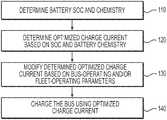
Schematic visualization of the patent's claim structure. Hand-drawn diagrams in progress for each landmark patent.
Where you've seen this
Real-world examples
Electric bus fleet charging stations
Commercial vehicle charging depots
Proterra electric buses
Smart charging infrastructure for public transport
Why it matters
The bigger picture
This patent is significant for optimizing the charging of electric vehicle fleets, especially those with varying battery types and operational demands like electric buses (ClaimclaimA numbered sentence at the end of a patent that legally defines what the inventor owns. The most important section.Read more → 9). Efficient charging extends battery life, reduces charging times, and can lower energy costs. Proterra, the assigneeassigneeThe entity that owns the patent — usually the inventor's employer or a company.Read more →, is known for manufacturing electric transit buses, making this technology directly relevant to their core business and the broader public transportation sector's transition to electric.
Filed
September 15, 2017
Granted
June 8, 2021
Market context
Who's building on this
Companies in this space
Proterra, the original assigneeassigneeThe entity that owns the patent — usually the inventor's employer or a company.Read more →, has been a key player in electric bus manufacturing and charging infrastructure. Other companies developing smart charging solutions for commercial electric fleets, such as ABB, Siemens, and ChargePoint, are likely building on similar principles to optimize charging efficiency and battery longevity for diverse vehicle types.
Market impact
This patent addresses a critical need in the electric vehicle market, particularly for commercial fleets: optimizing charging to extend battery life and operational efficiency. By enabling charging stations to adapt to specific battery types and real-time operational needs, it helps reduce the total cost of ownership for EV fleets. This approach supports the wider adoption of electric vehicles in public transit and logistics by making their charging infrastructure more intelligent and cost-effective.
Claim 1 — Plain English
What this patent covers
The patent outlines a method for an electric vehicle charging station to intelligently manage power delivery. First, as an electric vehicle approaches the station, the system "receives a chemistry of the battery system" (Claim 1), meaning it learns what type of battery it is (e.g., lithium-ion, nickel-metal hydride). After connecting, it figures out the battery's "state of charge" (how full it is) and the "passenger load" (Claim 1). Using a database that matches battery chemistry and charge level to a recommended current, it calculates an initial "charge current" (Claim 1). This current is then "adjusted... based on the determined passenger load" to become a "modified charge current" (Claim 1). The vehicle then charges using this modified current. As charging progresses, the system continuously monitors the "updated state of charge" and "adjusts the value of current" again (Claim 1) to optimize the charging process. For example, an electric bus (Claim 9) might communicate its battery type and current passenger count, allowing the charging station to deliver power efficiently, perhaps prioritizing a faster charge if many passengers are waiting or if it has a long route ahead.
The clever bit
The novelty lies in dynamically adjusting the charge current not just based on the battery's current charge level and its specific chemical makeup, but also factoring in external operational data like "passenger load" (Claim 1) and even "distance to be traveled... to the next charging event" (Claim 4). This allows for highly adaptive and efficient charging tailored to real-world vehicle use.
What it does not cover
- Does not cover charging systems that do not consider the specific "chemistry or type of the battery system" when determining the charge current (Claim 1).
- Does not cover charging methods that do not adjust the charge current based on "passenger load" (Claim 1).
- Does not cover systems that only determine a charge current once, without "determining an updated state of charge" and "adjusting the value of current" again during charging (Claim 1).
- Does not cover charging methods that manually set the current, rather than determining it from a database based on state of charge and chemistry (Claim 1).
- Does not cover charging methods that do not involve receiving battery chemistry specifically "as the electric vehicle approaches a charging station" (Claim 1).
Patent timeline
Application submitted to the patent office
Application published, typically 18 months after filing
Patent officially issued
Patent enters public domain
PatentBrief Score
Impact Score
Early stage
Citation count
14/40
Early citations
Claim breadth
7/20
Moderate scope
Recency
10/20
Granted 5–10 years ago
Assignee scale
0/20
Independent or smaller assigneeassigneeThe entity that owns the patent — usually the inventor's employer or a company.Read more →
PatentBrief Impact Score — based on citation count, claim breadth, recency, and assignee scale. Not a legal assessment.
Heuristic Value Estimate
What this patent might be worth
$34K – $108K
Midpoint $68K · 10.9 yr remaining · industry ×0.9
Heuristic only — blends forward/backward citation counts, claim scope, time remaining, litigation history, and CPC-derived industry baseline. Real valuations need a professional appraisal.
Claim text not yet imported for this patent
The original legal language
Original claims
10 claims as filed with the patent office.
Concepts involved
Citations
Patent lineage
Cite this patent
Grace, D., & McGrath, S. T. (2021). Smart Charging for Electric Vehicle Batteries Based on Chemistry and Use (U.S. Patent No. 11,027,624). U.S. Patent and Trademark Office. https://patentbrief.org/patent/us/11027624/electric-vehicle-charging-by-adjusting-charger-current-based-on-battery-chemistr
Auto-generated from the patent record. Double-check author order and the issue date against the official USPTO document before submitting.
Embed
Add this patent to your site
Drop this plain-English patent card into any blog post or article — free, no signup. It always links back to the full breakdown here.
<div data-patentlens-widget data-patent-number="US11027624"></div>
<script src="https://patentbrief.org/embed.js" async></script>
Stay in the loop
Get a weekly digest of new patents.
One email per week. No spam. Unsubscribe anytime.
Keep exploring
Related patents you should know
US 4683195 · 1987
How to Make Billions of Copies of a DNA Segment
This patent describes the Polymerase Chain Reaction (PCR), a method to rapidly create many copies of a specific piece of DNA or RNA, enabling its detection and analysis.
Cetus Corp
US 8697359 · 2014
How to Edit Genes in Human Cells Using an Engineered CRISPR System
This patent describes an engineered CRISPR-Cas9 system for precisely cutting DNA in eukaryotic cells to change how genes work, opening the door for gene editing in complex organisms.
Massachusetts Institute of Technology
US 7657849 · 2010
How the iPhone's Slide-to-Unlock Gesture Works
Apple's 2010 patent describes unlocking a device by dragging a specific graphical image across the touchscreen along a predefined path, a gesture that became iconic with the original iPhone.
Apple Inc
US 4733665 · 1988
How Doctors Implant a Permanent Stent Using a Balloon
This patent describes the method for placing a permanent, expandable wire mesh tube inside a blood vessel or other body tube using a balloon-tipped catheter to widen it and keep it open.
Expandable Grafts Partnership
US 4965188 · 1990
How to Make Many Copies of a DNA Piece with Heat
This patent describes the Polymerase Chain Reaction (PCR) method, a technique to make millions of copies of a specific DNA segment using a heat-resistant enzyme and repeated temperature changes.
Cetus Corp
US 4235871 · 1980
How to Encapsulate Active Materials in Lipid Bubbles Efficiently
This patent describes a method for trapping biologically active substances inside tiny, multi-layered fat bubbles called liposomes, using a specific water-in-oil emulsion and gel-forming process to improve how much material gets captured.
Individual
Semantically similar
You might also find these interesting
US 20120091953 · Tesla Motor
How Electric Cars Adjust Charging Speed to Available Power
US 9168838 · 2015 · NEC
How an EV Charging Station Manages Power from Batteries and the Grid
US 10700376 · 2020 · GM Global Technology Operations
How to Fast-Charge Lithium Batteries Without Damaging Them
US 11235681 · 2022 · Inventus Holdings
Smart EV Charging to Protect Battery Life During Long Parking
More to explore
More in Energy & Clean Tech
US RE49155 · 2022 · Halliburton Energy Services Inc
Electric or Natural Gas Blending and Pumping for Oil Wells
US 11436484 · 2022 · Nvidia Corp
Nvidia's Method for Training Self-Driving Car AI in Simulations
US 11840398 · 2023 · Titan Trailers Inc
How Titan Trailers Builds Stronger, Smoother Cargo Containers
US 2708656 · 1955
How the First Nuclear Reactor Works
New to patents?
Common Questions
Frequently Asked Questions
What does Smart Charging for Electric Vehicle Batteries Based on Chemistry and Use cover?
This patent describes a method for electric vehicle charging stations to adjust how fast they charge a battery based on its specific chemical type, its current charge level, and even how many passengers are on board.
Who owns patent US 11027624?
Proterra owns this patent, granted in 2021.
When does this patent expire?
This patent is expected to expire on September 15, 2037, when the invention enters the public domain.
What is patent US 11027624 cited by?
This patent has been cited by 4 later patents that build on its ideas.
What problem does this patent solve?
This patent is significant for optimizing the charging of electric vehicle fleets, especially those with varying battery types and operational demands like electric buses (Claim 9). Efficient charging extends battery life, reduces charging times, and can lower energy costs. Proterra, the assignee, is known for manufacturing electric transit buses, making this technology directly relevant to their core business and the broader public transportation sector's transition to electric.
What does this patent NOT cover?
Does not cover charging systems that do not consider the specific "chemistry or type of the battery system" when determining the charge current (Claim 1).
Patent monitoring